Research Notes
Strategy
- The equal-weight S&P 500's response to oversold conditions has been disappointing, with the index still drifting lower and internal deterioration worsening.
- More than half of the S&P 500 constituents are now below their 200-DMA, even as the cap-weighted index remains roughly 6% above its own.
- Relative trends have broken down the cap spectrum, with Russell 2000 vs. Russell 1000 below support and nearing a relative dark-cross, while mid caps are retesting their 2025 relative lows.
- Absolute trends in small and mid caps remain intact for now, but with relative leadership deteriorating, we would favor large caps here.
- The 10-yr yield broke above the prior cycle high to its highest level since July 2007, while bond volatility surged, reinofrcing the pressure from rising real yields.
- The equity reaction has been orderly so far, but the damage is showing up where higher rates hit first: Utilities, retail REITs, consumer services, restaurants and casinos are all deteriorating.
- Every sector now has fewer members above its 200-DMA than a month ago, while our mortgage-application model has moved into its bear zone, a six-month headwind for the S&P.
- Leadership has narrowed rather than broken. Energy, Tech, and Health Care still have a majority of names above trend, while Biotech continues to make new relative highs.
- The S&P 500 is at a 20-day high, but breadth remains narrow, with the equal-weight index oversold and fewer than 8% of members making 20-day highs.
- Tech, Health Care and Communication Services are doing most of the work, while Financials, Utilities, and Energy show very little participation.
- Industrials have rolled into a negative relative trend, reinforcing that leadership is narrowing beneath the surface.
- Crude is down roughly 10% from its mid-September peak, while refiners are showing excess enthusiasm after reaching a perfect momentum rank. We would not chase refiners here.
- Broad Energy is the better setup: the sector is approaching oversold while its uptrend remains intact.
- Long-term yields are consolidating, not falling, with real yields near the highest since 2008 and increasingly weighing on equity returns.
- Higher rates and the yield curve are becoming more important drivers of the market, particularly pressuring capital-intensive sectors.
- Credit has weakened modestly, but most of the recent stress appears rate and curve-driven rather than a deterioration in underlying credit quality.
- Watch full deGraaf video here
Economics
- We think two more Fed hikes in 2026 is a reasonable baseline, with October and December both in play.
- Warsh's language suggests September was the beginning of a tightening cycle, not the end. Removing a "dose of accommodation" implies policy is not yet restrictive enough to return inflation to target.
- Financial conditions remain too easy by Warsh's own description, while markets are priced for only a little more than one hike through year-end, leaving room for further repricing.
- If the Fed is serious about restoring price stability, higher unemployment is part of the transmission mechanism. September 2022 offers a useful template: higher front-end yields, curve flattening and weaker equities.
- Warsh was expected to look different from Powell, but on inflation he is increasingly sounding more like him than not.
- The rise in the 10-year yield is primarily a Fed story, not a growth story. Roughly 60bps of this year's increase reflects a repricing of monetary policy, with oil and higher global yields adding further pressure.
- The move is concentrated in real yields, which are up about 90bps while breakevens have barely moved, meaning the tightening is showing up through higher real borrowing costs rather than runaway inflation expectations.
- Fiscal concerns to not appear to be driving the selloff. The rise in yields has been global, with little relationship between countries' fiscal burdens and their bond-market performance.
- The broader picture is one of tighter monetary policy, resilient global growth and elevated oil prices, with September's acceleration in yields again largely driven by the Fed.
- September’s regional surveys do not point to a growth boom, with Richmond manufacturing slipping to -2 and the Chicago Fed activity index worsening to -4.55.
- Manufacturing is generally holding up better than services, but extended delivery times and elevated input costs remain an inflation concern with price pressures still firm.
- The S&P Global PMI is the notable outlier and deserves more weight given its larger sample and stronger emphasis on new orders, production and employment.
- Even so, survey strength is running ahead of actual factory output: manufacturing production is up less than 1% y/y, with 1.8% momentum versus roughly 4% historically implied by a PMI near 57.
- Unless production accelerates sharply or prior data are revised higher, the surveys appear to be overstating the underlying manufacturing rebound.
- New home sales role 6.4% in August to 684k SAAR, the strongest pace of the year, though much of the gain came from a volatile Midwest surge and sales remain roughly flat YoY.
- Builders are making progress clearing inventory, with completed unsold homes down 11.7% since January to the lowest level since February 2025.
- The improvement likely reflects aggressive concessions, with average new-home prices down 8.8% YoY and 11.4% YTD, pointing to weaker builder revenues even before the latest rise in mortgage rates.
 Sector Ranks
 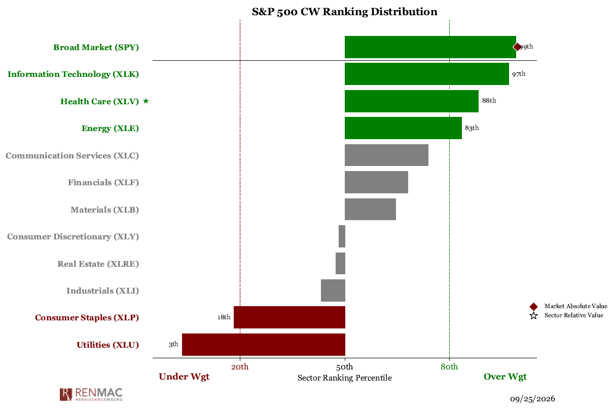 Chart of the weekOil pass-through into core inflation is still ongoing, adding roughly 0.1% to core PCE in both 2026 and 2027. The effect is modest compared with 2022-24, but it is not yet finished, especially with oil prices rising again in August and September. Oil is contributing to underlying inflation, but it is not the main reason core inflation remains elevated.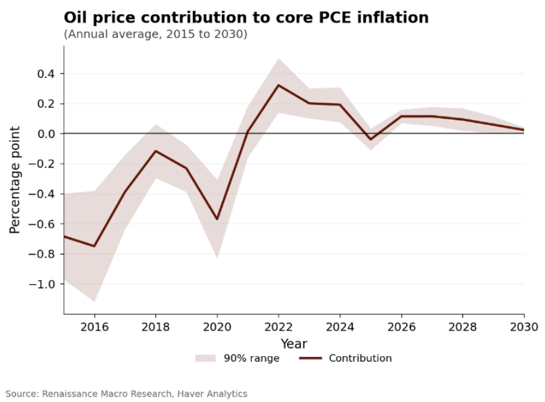
RenMac Off-Script Podcast

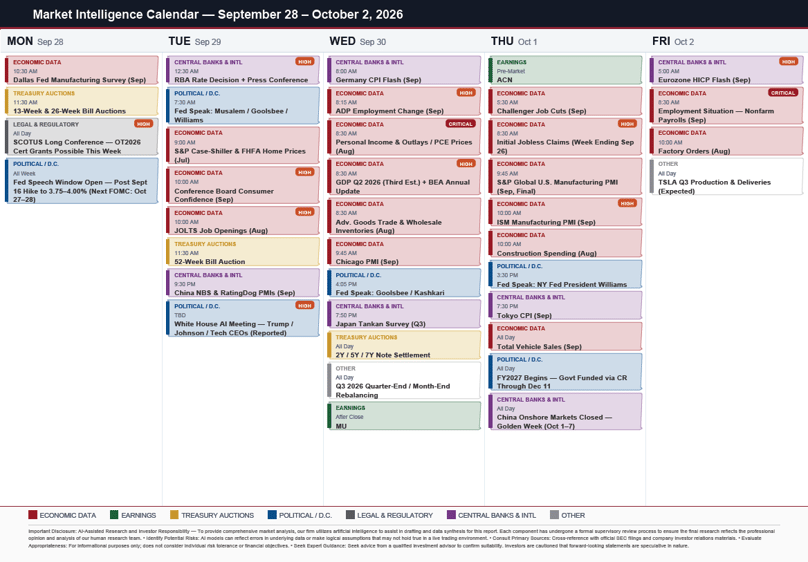
RenMac Calendar
Research Notes
Economics
- US labor market continues its downtrend. Weekly job postings continue to trend down, layoffs picking up, quits are cooling.
- March data showed broad economic weakness, with declines in services, confidence, housing, and commercial real estate.
- Rising inflation, weakening job outlooks, and cautious business spending point to growing economic strain.
- Home prices are cooling, which may curb spending as household wealth dips and the savings rate edges higher.
- The rebound in capital goods shipments looks fragile, with growth mostly tied to tech and broader investment plans weakening.
- New tariffs could cut 0.5% from GDP, strain trade ties, and raise car prices before production shifts take effect.
- Auto repossessions are at their highest since 2009, and tariffs may push buyers to the used market, keeping prices elevated.
- Despite trade tensions, signs of de-escalation and strong profits offer some cushion, with markets already pricing in much of the downside.
- Q4 growth was lifted by consumer and government spending, but with investment falling and key supports fading, a broader slowdown seems likely.
Strategy
- Market technicals show potential for a rebound. We think Mag7 approaches 50dma and potentially crosses through, getting to overbought, high beta stocks slowly recovering, and excessive outflows in IWM and SPY could fuel a tactical bounce.
- Remember, this was a beta-driven correction, not a momentum-driven one.
- Remember, this was a beta-driven correction, not a momentum-driven one.
- Bullish signals may re-emerge if a high percentage of stocks move about their 20dma and hit 20-day highs, suggesting a reassertion of the bull trend.
- Despite heightened policy uncertainty and a dark cross in tech, strong credit markets and sentiment tied to returns suggest the current pessimism may be overdone.
- Semi's continue to weaken, with even "good" ones coming under pressure.
- Staples pulled back at resistance levels, maintaining relative downtrend. Sharp unwind in beta and extreme underperformance suggests continued downward pressure.
- Transports reiterate bearish trend but flagging oversold and in "seller's frenzy". Expect short-term tactical bounce but fade the move.
Policy
- Debt limit deadline ("X-Date") likely between July and October, with resolution hinging on reconciliation or bipartisan deal amid uncertain cash flows.
- Delays risk market volatility and a Moody's downgrade, raising U.S. borrowing costs.
- Delays risk market volatility and a Moody's downgrade, raising U.S. borrowing costs.
- Trump will announce reciprocal tariffs on April 2, targeting about 15 key partners; recent moves on oil, autos, and threats to the EU and Canada may be strategic leverage.
- Section 232 is being used more broadly to justify tariffs on national security grounds, covering autos, copper, timber, and pharma, with an emphasis on U.S. production.
- Tariff timing and scope remain unclear, with Trump using them as a flexible tool, adding to market uncertainty.
Asset Allocation Model
 Sector Ranks
  Chart of the week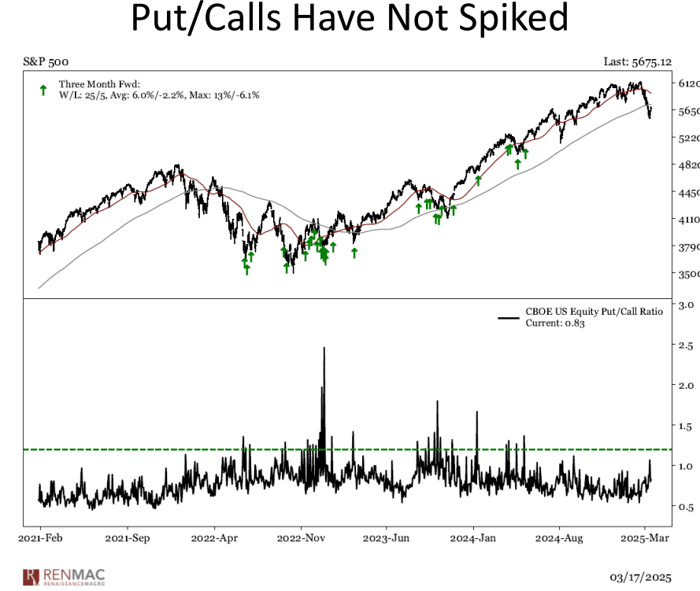
Sector Ranks Chart of the week