Research Notes
Strategy
- The Fed delivered a 25bp hike, confirming inflation remains too high, but the market response was concentrated at the front end rather than across the curve.
- The 2-year yield rose to 4.74% Wednesday, its highest in more than two years, while the 30-year slipped slightly, reinforcing the flattening signal and the risk of a policy mistake.
- The S&P fell just 0.45%, and only 30.2% of equal-weight issues made 20-day lows, still well short of the 50% washout threshold we associate with more meaningful stress.
- The tape is tactically oversold but not yet washed out. With the Market Cycle Clock in a historically vulnerable zone, we would prefer a deeper internal cleanse before becoming more aggressive.
- The 10-year yield hit 5%, moving above its 2023 peak and pushing our Yield Impact Model into a zone associated with lower forward S&P returns.
- The signal is a headwind, not a bull-market killer. Historically, 65-day forward returns are roughly flat rather than sharply negative.
- At these levels, the index stops paying you simply to be long, putting more emphasis on sector selection and extracting returns beneath the surface.
- 5% yields punish capital dependency more than growth itself. The pressure is showing up in homebuilders, capital goods and REITs, where business models rely more heavily on cooperative credit markets.
- That argues against a simple growth vs. value framework. The better distinction is between companies that need external capital and those that fund themselves through strong balance sheets and cash flow.
- Banks, Pharma/Biotech, Energy, Insurance, and parts of Tech remain among the groups holding up best above their 200-DMAs.
- That argues against a simple growth vs. value framework. The better distinction is between companies that need external capital and those that fund themselves through strong balance sheets and cash flow.
- Two of our conditional models turned bearish on Wednesday's data, import prices at 7.0% year over year and the inventory-to-sales ratio. One carries a t-statistic of 2.07, the other −1.56. Both suggest headwinds and skew bearishly SPX.
- Tech led Thursday's strength, with Semis and Software advancing together and equal-weight R1K Tech breaking to a 3-month relative high.
- Tech has the highest percentage of stocks above their 20-DMA of any sector, though this is not yet a momentum resurgence.
- We still expect high vs. low Tech momentum to grind lower through year-end, but individual winners are beginning to separate from the pack.
Economics
- Warsh came across more hawkish than most of the FOMC, and importantly, he offered little sense of what would make the Fed stop hiking.
- The September hike looks more like the start of a tightening sequence than a one-off move, with Warsh emphasizing price stability, accommodative financial conditions and the need to remove "a dose of accommodation".
- Warsh explicitly pushed back on Waller-style single-data-point dependence, suggesting it may take a sustained change in the trend, rather than one good inflation report, to alter his stance.
- He also highlighted commodity prices as a risk, echoing the hawkish framework he used in 2008 as energy and agricultural prices remain elevated.
- The biggest takeaway is the lack of an obvious off-ramp: if financial conditions remain easy and inflation stays above target, Warsh may keep tightening until something in the economy materially weakens.
- A "timelier" return to 2% inflation means slowing the economy sooner, and Warsh's own language suggests the Fed does not view current policy as especially restrictive.
- We continue to expect hikes in October and December.
- The SEP actually moved in a hawkish direction: lower unemployment, higher core PCE and a higher neutral rate. Yet the Fed only penciled in one additional rate hike, which looks somewhat dovish relative to the forecast revisions.
- A Taylor-Rule framework points to roughly 50bps more tightening than the Fed currently signals.
- Consumer spending reaccelerated sharply in August, with retail sales up 1.2% and control sales up 1.4%, lifting our Q3 real PCE tracking to roughly 3.5%-4.0%.
- Strength was broad-based, with restaurants posting a fifth straight monthly gain and furniture/appliance sales remaining surprisingly firm despite weak housing turnover.
- We still doubt the pace is sustainable. Higher food and energy costs, rising borrowing rates, weak housing activity and limited room for the savings rate to fall all point to softer consumption ahead.
- Household pressure is building into year-end, with wages and salaries up roughly 3.5% YoY vs. 7% inflation in food and energy.
- Similar gaps have historically appeared around major stress periods, including 2007-08 and the post-Katrina energy shock, while today's savings rate is already comparatively low.
- Food and energy inflation should remain a drag as agricultural costs, diesel and gasoline rise, leaving households with less room to absorb the shock through savings.
- The key offset would be a stronger labor market. Faster wage and salary growth could provide some relief, but absent that, the consumer squeeze is likely to intensify.
 Sector Ranks
  Chart of the weekAs another weekend likely full of Middle East headlines approaches, especially since Trump said that he is at a “critical juncture” regarding the war in Iran, we included a chart highlighting key support and resistance levels in crude. The first meaningful support is at the July highs of $93.50, followed by the uptrend near $85 and the 200-DMA at $80.75. We see little notable resistance between here and the prior highs of $119.50. The dollar has strengthened over the past two weeks and looks poised for another run at the YTD highs. While the chart has largely moved sideways over the past year and a half, since bottoming in January it has made higher highs and higher lows while regaining the 200-DMA. That’s an uptrend in our book, and we remain bullish with a stop on a break below the tactical uptrend.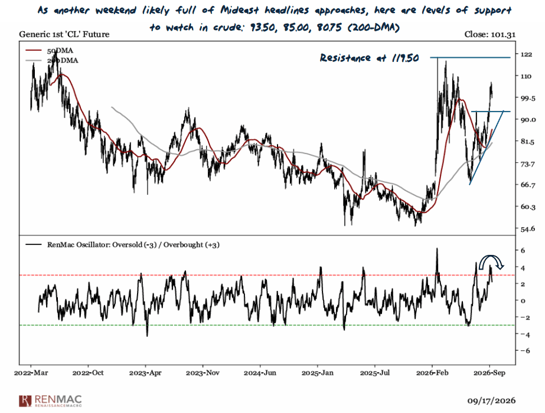
RenMac Off-Script Podcast

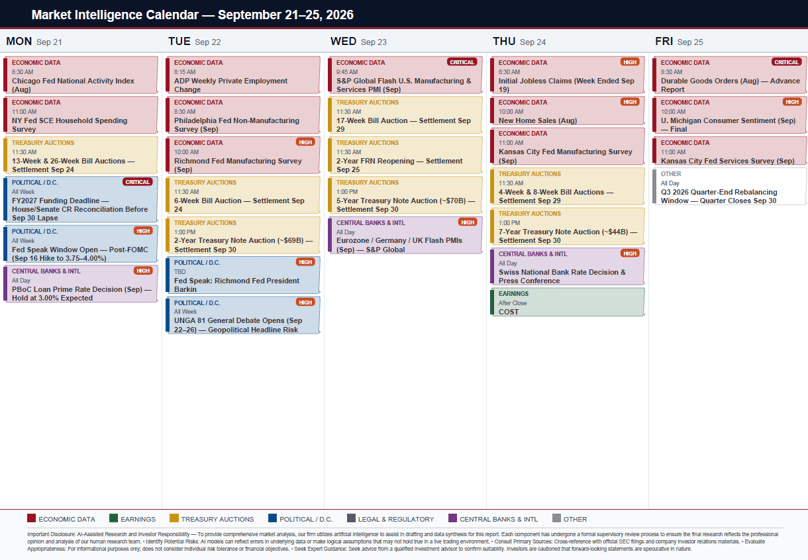
RenMac Calendar
Research Notes
Economics
- US labor market continues its downtrend. Weekly job postings continue to trend down, layoffs picking up, quits are cooling.
- March data showed broad economic weakness, with declines in services, confidence, housing, and commercial real estate.
- Rising inflation, weakening job outlooks, and cautious business spending point to growing economic strain.
- Home prices are cooling, which may curb spending as household wealth dips and the savings rate edges higher.
- The rebound in capital goods shipments looks fragile, with growth mostly tied to tech and broader investment plans weakening.
- New tariffs could cut 0.5% from GDP, strain trade ties, and raise car prices before production shifts take effect.
- Auto repossessions are at their highest since 2009, and tariffs may push buyers to the used market, keeping prices elevated.
- Despite trade tensions, signs of de-escalation and strong profits offer some cushion, with markets already pricing in much of the downside.
- Q4 growth was lifted by consumer and government spending, but with investment falling and key supports fading, a broader slowdown seems likely.
Strategy
- Market technicals show potential for a rebound. We think Mag7 approaches 50dma and potentially crosses through, getting to overbought, high beta stocks slowly recovering, and excessive outflows in IWM and SPY could fuel a tactical bounce.
- Remember, this was a beta-driven correction, not a momentum-driven one.
- Remember, this was a beta-driven correction, not a momentum-driven one.
- Bullish signals may re-emerge if a high percentage of stocks move about their 20dma and hit 20-day highs, suggesting a reassertion of the bull trend.
- Despite heightened policy uncertainty and a dark cross in tech, strong credit markets and sentiment tied to returns suggest the current pessimism may be overdone.
- Semi's continue to weaken, with even "good" ones coming under pressure.
- Staples pulled back at resistance levels, maintaining relative downtrend. Sharp unwind in beta and extreme underperformance suggests continued downward pressure.
- Transports reiterate bearish trend but flagging oversold and in "seller's frenzy". Expect short-term tactical bounce but fade the move.
Policy
- Debt limit deadline ("X-Date") likely between July and October, with resolution hinging on reconciliation or bipartisan deal amid uncertain cash flows.
- Delays risk market volatility and a Moody's downgrade, raising U.S. borrowing costs.
- Delays risk market volatility and a Moody's downgrade, raising U.S. borrowing costs.
- Trump will announce reciprocal tariffs on April 2, targeting about 15 key partners; recent moves on oil, autos, and threats to the EU and Canada may be strategic leverage.
- Section 232 is being used more broadly to justify tariffs on national security grounds, covering autos, copper, timber, and pharma, with an emphasis on U.S. production.
- Tariff timing and scope remain unclear, with Trump using them as a flexible tool, adding to market uncertainty.
Asset Allocation Model
 Sector Ranks
  Chart of the week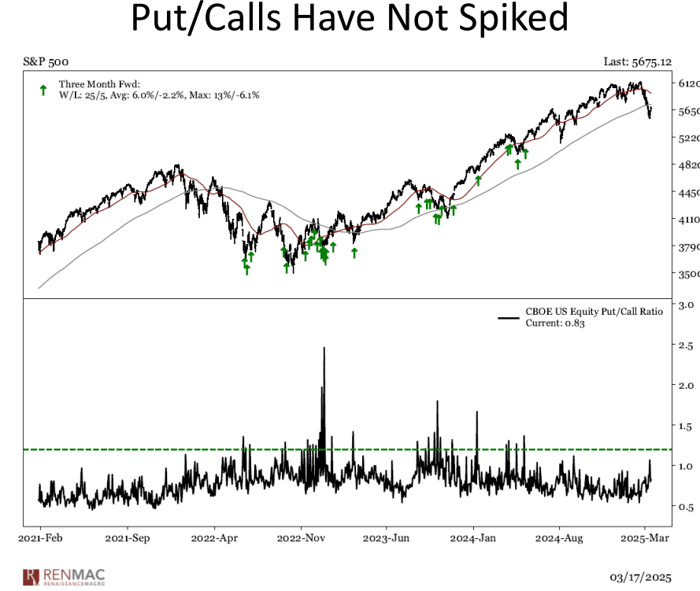
Sector Ranks Chart of the week