Research Notes
Strategy
- The Fed held and the market responded with a bull steepener, as the 2-year fell about 5bp while the 10-year held near 5%.
- Breadth has improved across nearly every sector except Technology, where momentum has slipped to the 47th percentile despite a still-positive relative trend.
- Communication Services and Investment Banks & Brokers have flipped bearish, while earnings continue to reward restraint over heavy spending.
- With the 10-year near 5%, the market is increasingly charging capital-intensive companies and rewarding cleaner cash-flow stories.
- Our breadth thrust signal has fired. While it was led by defensives, it’s a key bullish indicator for market participation and capital remaining in equities.
- Historically, this resets the bull market shot clock and the S&P is higher 11 out of 12 instances 3m and 6m out. Investors are selling the AI trade, but they aren’t taking their ball and moving to bonds or cash.
- Instead, they’re rotating defensively within equities into areas such as health care (our favorite sector), staples, energy, software, quality, and value.
- Watch 2 minute video here
- The Equal-weight S&P is approaching an important test as it reaches a flattening 50-DMA after nearing +3 on our oscillator.
- Trends and breadth remain intact, but we want to see how the index handles overbought conditions before pressing exposure.
- November is historically the S&P's best month, but a significant seasonal headwind for equal-weight Energy, with just a 32% win rate and the median excess return near -200bps.
- We would add on weakness rather than chase strength into those seasonal headwinds.
- Alphabet's roughly $500B market-cap loss masked a much healthier tape underneath, with 777 Russell 1000 stocks advancing and the median stock gaining 1.4% Thursday.
- Equal-weight S&P outperformed cap-weight by roughly 1.5 points, a 99th-percentile spread, suggesting Thursday was more rotation than broad market weakness.
- Communication Services had already been deteriorating on a relative basis, reinforcing the value of relative strength in identifying weakness before the headline break.
- The market is increasingly rewarding cash generation over capital intensity. Alphabet and Amazon were punished, while Lily's stronger fundamentals were rewarded.
- Health Care remains the beneficiary, with relative highs across Pharma, Biotech and Diagnostics. Sentiment is stretched, so we would stay long but prefer adding on consolidation rather than chasing strength.
- Aerospace & Defense bounced roughly 5%, but the group remains one of the weakest areas in the market.
- The relative trend is still negative and momentum sits in the 29th percentile, so we would treat the bounce as sellable strength.
Economics
- The Fed held rates, but the broader message remains hawkish, with Warsh still unwilling to call financial conditions tight and September's hike only removing a "dose of accommodation".
- The Fed may be settling into an every-other-meeting hiking cadence, but that gradualism risks leaving inflation above target for longer and has already helped push breakevens higher.
- With growth still describing as strong and inflation elevated, the bias remains toward additional tightening.
- The main risk is that skipping hikes now simply means more tightening later.
- Central banks are still leaning hawkish, but the underlying growth backdrop argues for caution on how much tightening can actually be delivered.
- The BoC hiked 25bps to 2.5% to limit the risk of energy inflation spreading, even with core inflation near 2% and excess supply still evident.
- That makes us skeptical the BoC can deliver as many hikes as markets currently price, especially with labor-market slack and softer growth ahead.
- In the euro area, credit conditions are tightening further while loan demand is weakening, particularly in housing, adding another restraint on activity.
- US growth remains firm, with Q3 GDP up 3.4% SAAR and private domestic demand running even stronger at roughly 5%.
- Consumer spending and business investment continue to support activity, while jobless claims remain low, showing little sign of labor-market deterioration.
- The near-term caution is Q4: September consumption was flat and the saving rate fell to 3.8%, leaving less cushion if markets weaken further.
- Firms are seeing stronger sales, healthier hiring and rapidly rising AI investment, suggesting the business sector is not bracing for a slowdown.
- Sales growth has accelerated to 6.1% YoY, while employment growth is running near pre-pandemic norms and hiring plans have firmed.
- AI adoption is already widespread, with spending per employee expected to roughly double from $522 to $1,024.
- For now, AI investment is occurring alongside more hiring, not replacing it.
- Consumers are seeing a firmer labor market and remain optimistic on equities, pushing back against near-term fears around AI-driven job losses.
- The Conference Board's Labor Differential rose to its best level since April, driven by more consumers saying jobs are plentiful.
- Equity sentiment remains elevated, with the net share expecting higher stock prices at 24.9, more than one standard deviation above normal.
- Bottom line, consumers still see a stable-to-improving jobs backdrop and a constructive equity outlook.
- The AI build-out is becoming increasingly debt-funded, with hyperscalers on track to spend more than $800B on capex and bond issuance already reaching $222B.
- Off-balance-sheet financing is adding another $75-$100B, concentrating risk across hyperscalers, insurers, private credit and banks.
- The structures are vulnerable because commitments can exceed reported debt and chips are weak collateral given how quickly they depreciate.
- Spillovers to yields have been limited so far, but if issuance continues at this pace, long-term rates are likely to feel more pressure.
- Read more from BIS
 Sector Ranks
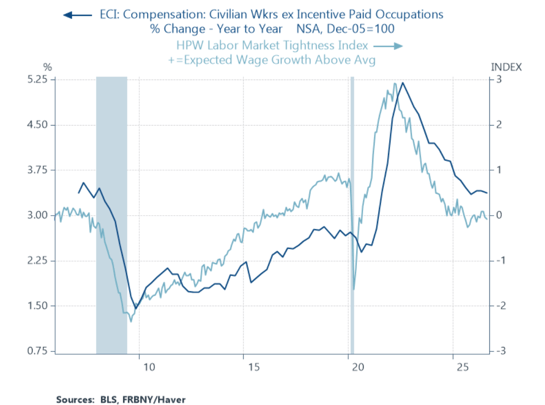
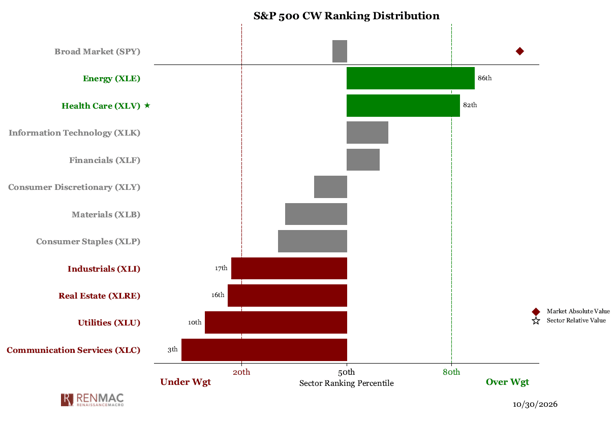 Chart of the weekCompensation growth appears to be stabilizing just over 3.0 percent. Given the growth in labor productivity, this is broadly consistent with the Fed's inflation objective. Of course, labor markets haven't been a source of inflationary pressure for a while now, but inflation still remains a problem.
RenMac Off-Script Podcast

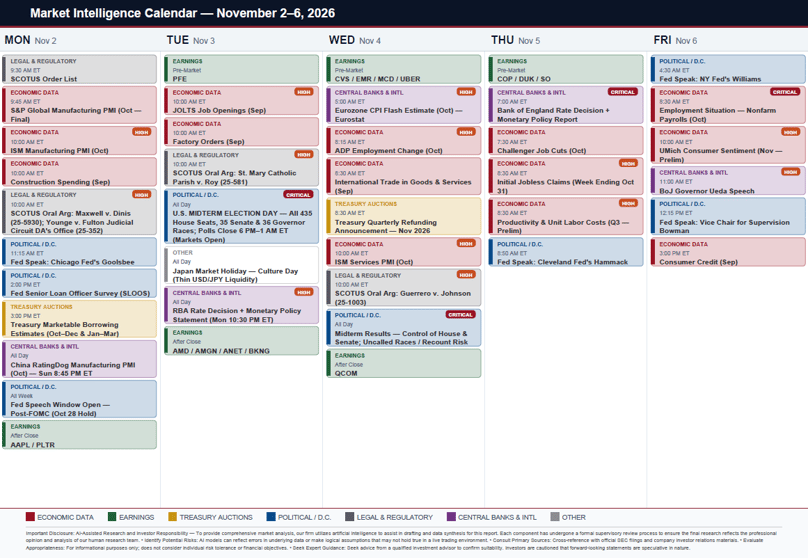
RenMac Calendar
Research Notes
Economics
- US labor market continues its downtrend. Weekly job postings continue to trend down, layoffs picking up, quits are cooling.
- March data showed broad economic weakness, with declines in services, confidence, housing, and commercial real estate.
- Rising inflation, weakening job outlooks, and cautious business spending point to growing economic strain.
- Home prices are cooling, which may curb spending as household wealth dips and the savings rate edges higher.
- The rebound in capital goods shipments looks fragile, with growth mostly tied to tech and broader investment plans weakening.
- New tariffs could cut 0.5% from GDP, strain trade ties, and raise car prices before production shifts take effect.
- Auto repossessions are at their highest since 2009, and tariffs may push buyers to the used market, keeping prices elevated.
- Despite trade tensions, signs of de-escalation and strong profits offer some cushion, with markets already pricing in much of the downside.
- Q4 growth was lifted by consumer and government spending, but with investment falling and key supports fading, a broader slowdown seems likely.
Strategy
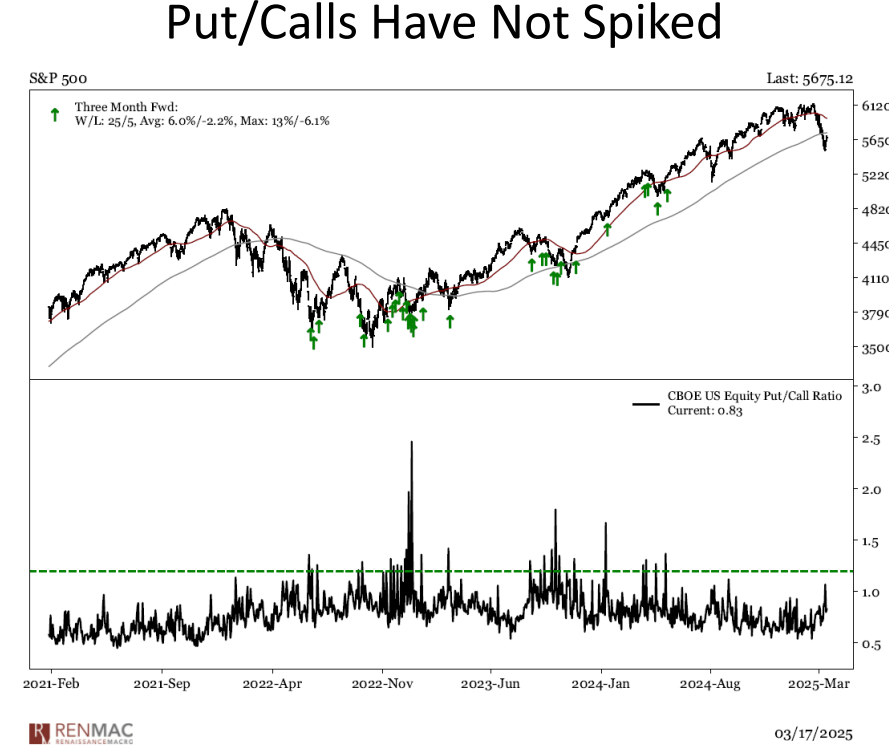
- Market technicals show potential for a rebound. We think Mag7 approaches 50dma and potentially crosses through, getting to overbought, high beta stocks slowly recovering, and excessive outflows in IWM and SPY could fuel a tactical bounce.
- Remember, this was a beta-driven correction, not a momentum-driven one.
- Remember, this was a beta-driven correction, not a momentum-driven one.
- Bullish signals may re-emerge if a high percentage of stocks move about their 20dma and hit 20-day highs, suggesting a reassertion of the bull trend.
- Despite heightened policy uncertainty and a dark cross in tech, strong credit markets and sentiment tied to returns suggest the current pessimism may be overdone.
- Semi's continue to weaken, with even "good" ones coming under pressure.
- Staples pulled back at resistance levels, maintaining relative downtrend. Sharp unwind in beta and extreme underperformance suggests continued downward pressure.
- Transports reiterate bearish trend but flagging oversold and in "seller's frenzy". Expect short-term tactical bounce but fade the move.
Policy
- Debt limit deadline ("X-Date") likely between July and October, with resolution hinging on reconciliation or bipartisan deal amid uncertain cash flows.
- Delays risk market volatility and a Moody's downgrade, raising U.S. borrowing costs.
- Delays risk market volatility and a Moody's downgrade, raising U.S. borrowing costs.
- Trump will announce reciprocal tariffs on April 2, targeting about 15 key partners; recent moves on oil, autos, and threats to the EU and Canada may be strategic leverage.
- Section 232 is being used more broadly to justify tariffs on national security grounds, covering autos, copper, timber, and pharma, with an emphasis on U.S. production.
- Tariff timing and scope remain unclear, with Trump using them as a flexible tool, adding to market uncertainty.
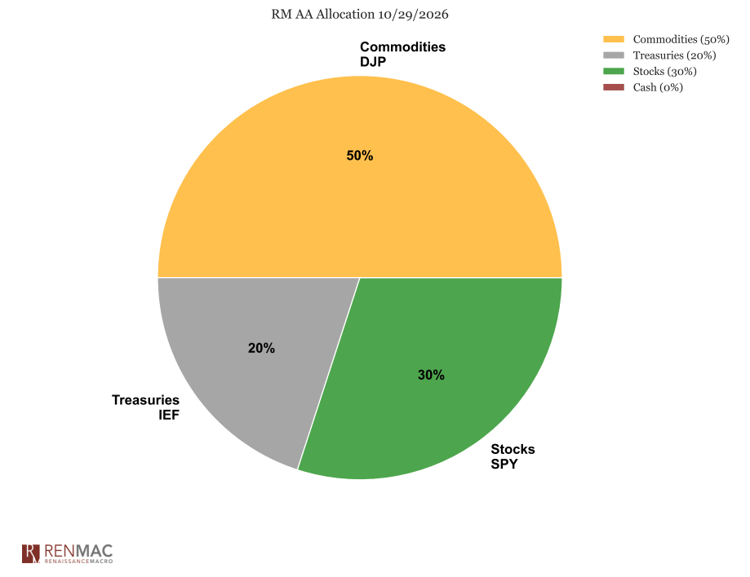
Asset Allocation Model
 Sector Ranks
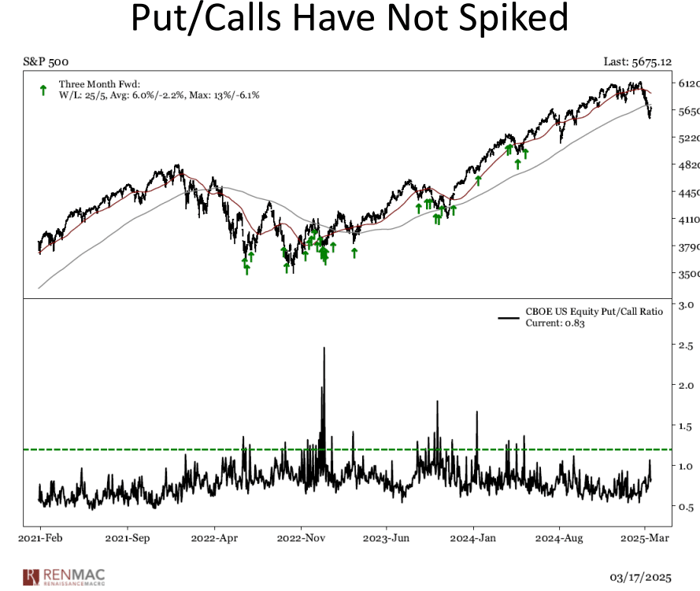
 Chart of the week
Sector Ranks Chart of the week