Research Notes
Strategy
- The S&P 500 finished Q3 only about 2% below its high, but the average stock is telling a much weaker story.
- Just 40% of equal-weight S&P names remain above their 200-DMA, the weakest since April 2025, while the Equal-weight index is on pace for a seventh straight weekly decline.
- Prior spikes like Wednesday's 9% of stocks closing on their lows were followed by a lower equal-weight index three months later in 10 of 13 cases.
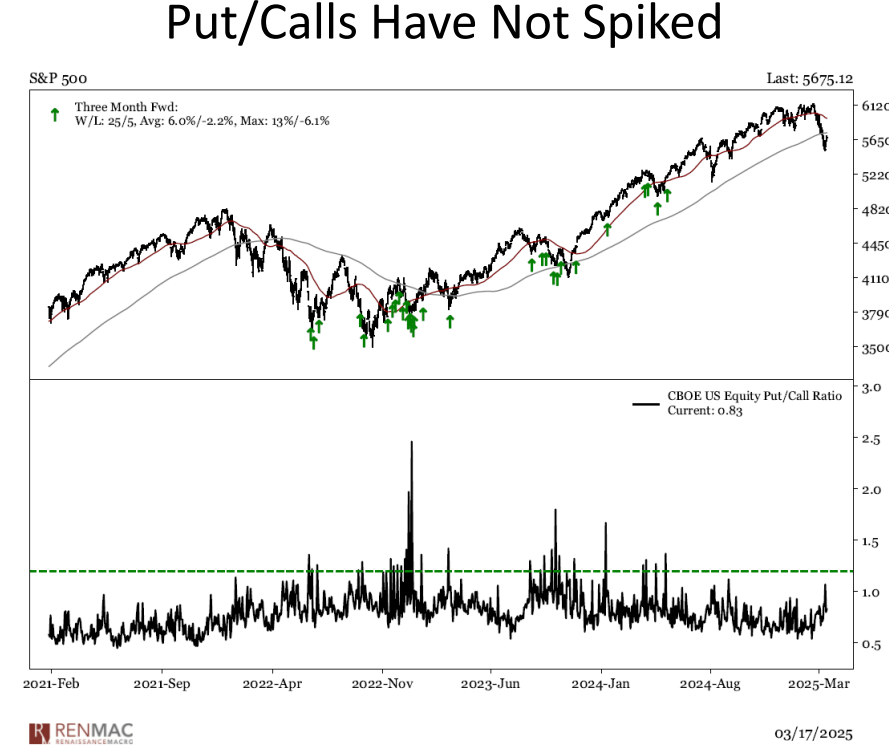
- Despite the deterioration, sentiment remains elevated, with Investors Intelligence bulls well ahead of bears and put/call ratios showing early complacency even as rates and fuel pressure consumers.
- Optimism is running well ahead of the average stock, with Technology carrying the market after a fresh relative breakout while broader participation continues to weaken.
- Softer PCE reduced October hike odds, but the long end remained under pressure, with the 30-year climbing to 5.64% and staying overbought.
- Utilities are showing signs of capitulation, with the sector at a 52-week low, relative performance near a three-year low and our Seller's Frenzy work at an extreme.
- Since 2008, similar pessimism has been followed by three-month outperformance 11 of 12 times, and October has historically been the best month of the year for equal-weight Utilities.
- The setup is still counter-trend, with the group's trend model remaining bearish. We want confirmation before leaning in more aggressively; for now, it is an interesting contrarian setup, not an all-clear.
- The 10-year reached its highest level since 2002 before reversing, sparking a bounce in oversold areas like small caps, Industrials and Financials.
- We're not calling an all-clear yet. The market still lacks a meaningful washout, particularly a spike in 20-day lows that would signal genuine stress.
- Rising yields are also spreading overseas, with France CDS at its highest since 2013. A little more upside in yields could be enough to finally push volatility materially higher.
Economics
- September payrolls were dovish at the margin, with just 29k jobs added, 60k of downward revisions to prior months, softer wage growth and unemployment edging up to 4.2%.
- The labor market is slowing, but not collapsing: the three-month payroll average is 51k, the rise in unemployment was not driven by layoffs, and goods-producing sectors still added jobs.
- Wage softness is broad-based, not confined to one industry, with several sectors now near the low end of their 12-month wage-growth ranges.
- This gives the FOMC doves more room to argue there is no urgency to hike again immediately, but labor is not the main source of the Fed's inflation concern.
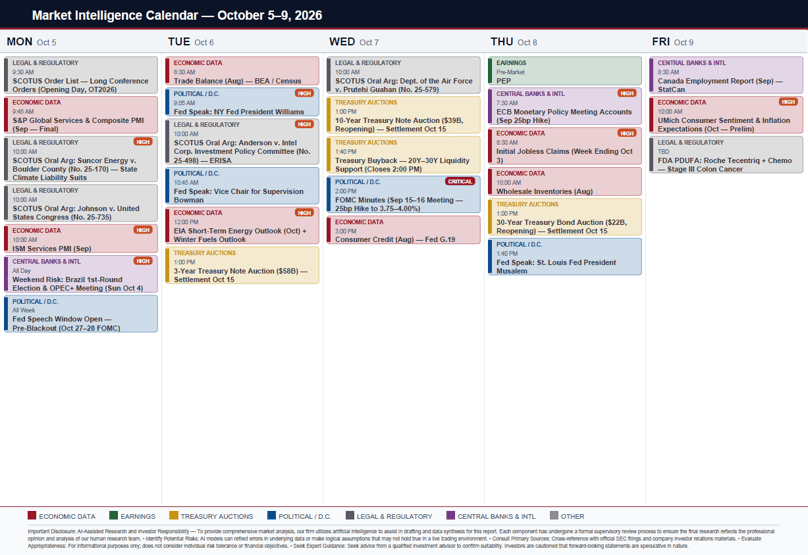
- The next inflation report matters more. With spot inflation risks still skewed to the upside into early 2027, the unemployment report alone does not close the door on further tightening.
- Three-month core PCE has slowed to 2.0% SAAR, but that is not enough to take an October hike off the table.
- The Fed likely knew this reading was coming ahead of the September meeting and hiked anyway, while the soft June print will roll out of the three-month calculation next month.
- The inflation risk remains skewed to the upside, with more energy pass-through, higher food costs and price increases in smartphones and subscription services still working through.
- Residual seasonality is another concern heading into 2027, with Q1 core PCE repeatedly running hot in recent years.
- With inflation still elevated and growth holding up, another October hike remains live, and it is difficult to get long the front end of the Treasury curve.
- Barr sounds ready to hike again in October, while Williams is pushing for more patience and leans against consecutive moves.
- Markets sided with Williams, taking October hike odds down.
- If inflation keeps surprising to the upside, Williams' "no urgency" stance becomes harder to defend and another hike remains very much in play.
- The ISM Manufacturing PMI held at 54.5 in September, consistent with roughly 2.4% annualized real GDP growth and continued expansion in the factory sector.
- New orders and employment improved, while low inventories suggest the recent cooling in production may prove temporary.
- Prices remain the bigger issue, with prices paid jumping to 77.9 and delivery times still extended. With employment firm and inflation pressures elevated, the backdrop remains consistent with further Fed tightening.
- Higher mortgage rates are already weighing on housing, with Redfin pending sales down roughly 7% YoY through September 20.
- Contract cancellations are also rising, reaching their highest level for this time of the year since 2022.
- The message is straightforward: the latest backup in rates is renewing pressure on existing-home activity.
 Sector Ranks
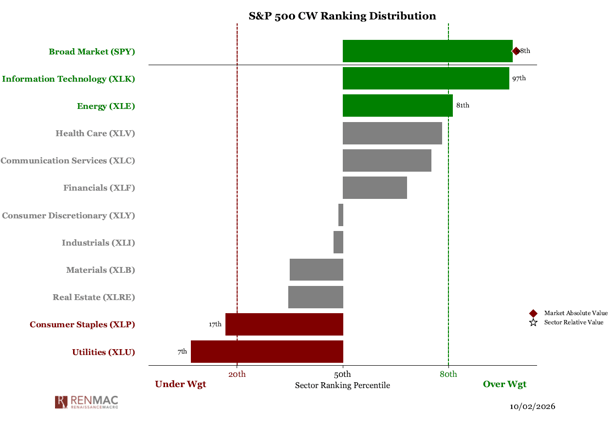 Chart of the week
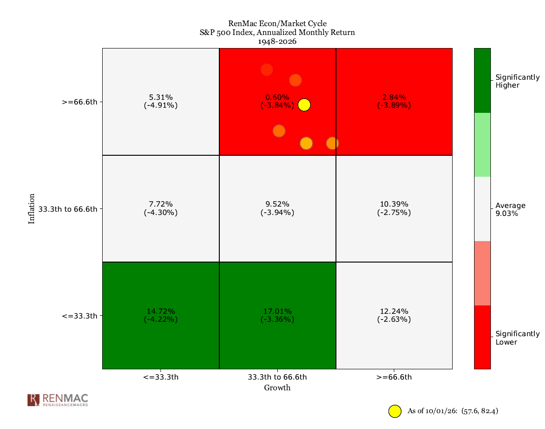
The latest update to our Market Cycle Clock saw an unsurprising lift in the inflation component putting it squarely in the weakest zone for equities. Historical sector performance in this zone is mostly aligned with current performance as Energy tends to dominate here while Real Estate and Industrials lag. As we’ve mentioned before, hiking rates in this area of the Cycle Clock is concerning. There have been many 20% drawdowns when inflation and growth are in similar positioning, several of which have occurred while the fed is raising rates. Taking a trip down memory lane, in 2018, rates were rising with a new Fed Chart while the market was in the upper right zone and again in October of 1987. We’re not calling for a crash but just a reminder that bad things tend to happen when growth and inflation are in a similar position while the Fed is raising rates.

Research Notes
Economics
- US labor market continues its downtrend. Weekly job postings continue to trend down, layoffs picking up, quits are cooling.
- March data showed broad economic weakness, with declines in services, confidence, housing, and commercial real estate.
- Rising inflation, weakening job outlooks, and cautious business spending point to growing economic strain.
- Home prices are cooling, which may curb spending as household wealth dips and the savings rate edges higher.
- The rebound in capital goods shipments looks fragile, with growth mostly tied to tech and broader investment plans weakening.
- New tariffs could cut 0.5% from GDP, strain trade ties, and raise car prices before production shifts take effect.
- Auto repossessions are at their highest since 2009, and tariffs may push buyers to the used market, keeping prices elevated.
- Despite trade tensions, signs of de-escalation and strong profits offer some cushion, with markets already pricing in much of the downside.
- Q4 growth was lifted by consumer and government spending, but with investment falling and key supports fading, a broader slowdown seems likely.
Strategy
- Market technicals show potential for a rebound. We think Mag7 approaches 50dma and potentially crosses through, getting to overbought, high beta stocks slowly recovering, and excessive outflows in IWM and SPY could fuel a tactical bounce.
- Remember, this was a beta-driven correction, not a momentum-driven one.
- Remember, this was a beta-driven correction, not a momentum-driven one.
- Bullish signals may re-emerge if a high percentage of stocks move about their 20dma and hit 20-day highs, suggesting a reassertion of the bull trend.
- Despite heightened policy uncertainty and a dark cross in tech, strong credit markets and sentiment tied to returns suggest the current pessimism may be overdone.
- Semi's continue to weaken, with even "good" ones coming under pressure.
- Staples pulled back at resistance levels, maintaining relative downtrend. Sharp unwind in beta and extreme underperformance suggests continued downward pressure.
- Transports reiterate bearish trend but flagging oversold and in "seller's frenzy". Expect short-term tactical bounce but fade the move.
Policy
- Debt limit deadline ("X-Date") likely between July and October, with resolution hinging on reconciliation or bipartisan deal amid uncertain cash flows.
- Delays risk market volatility and a Moody's downgrade, raising U.S. borrowing costs.
- Delays risk market volatility and a Moody's downgrade, raising U.S. borrowing costs.
- Trump will announce reciprocal tariffs on April 2, targeting about 15 key partners; recent moves on oil, autos, and threats to the EU and Canada may be strategic leverage.
- Section 232 is being used more broadly to justify tariffs on national security grounds, covering autos, copper, timber, and pharma, with an emphasis on U.S. production.
- Tariff timing and scope remain unclear, with Trump using them as a flexible tool, adding to market uncertainty.
 Sector Ranks
 Chart of the week