Research Notes
Strategy
- The S&P 500 is making new highs, but the climb is increasingly narrow, with equal-weight versus cap-weight at its weakest level in nearly two decades and small caps lagging even as yields fall.
- Credit is also diverging, with HYG at a new low while the S&P makes a new high, a rare setup that has typically resolved through weaker equities.
- Historically, similar divergences have produced a -3.5% median S&P return 13 weeks later, suggesting the index may eventually have to catch down to what credit is signaling.
- Utilities are responding to the capitulation and Seller's Frenzy signals we highlighted last week, with the group leading the S&P 500 higher by 3% Tuesday after Google's 20yr nuclear agreement with Constellation.
- Participation was broad, with every Russell 1000 equal-weight Utility advancing, suggesting the move was about more than one contract.
- With only 12% of the group above its 200-DMA, positioning still looks extremely depressed, reinforcing the idea that sellers may simply be running out.
- Note our “Underweight” Utilities in the sector model. Our utility call above, is tactical, and takes place within a more strategic underweight. Those are trades, not long-term recommendations.
- Equal-weight equities have fallen to a one-year relative low versus cap-weight, with Industrials suffering a two-standard deviation decline Wednesday and weakness clustering in the most capital-dependent areas.
- Machinery, homebuilders, SPACs, BDCs and listed private equity are all deteriorating, while the market continues to favor the parts of AI that can fund themselves rather than rely on borrowed money.
- Nothing has broken yet, but the message is familiar: higher rates find leverage first, and the market is increasingly showing us where that leverage is concentrated.
- AI expectations, particularly around OpenAI, were called into question as Semis fell 3.4% Thursday, with optics, power and data-center names hit even harder while prior AI "victims" led the tape.
- Semis reached an overbought condition and failed there, echoing the same breadth warning seen around the spring highs.
- Strong trends tend to ignore overbought readings; weakening or transitioning trends fail at them. Thursday's reversal makes that failure notable.
- The S&P 500 trend remains constructive, but participation is narrow, with only 8% of stocks making 20-day highs, consistent with a grinding advance rather than a broad momentum rally.
- Bullish sentiment is elevated relative to recent returns, while weak breadth near all-time highs signals a three-month risk window, supporting low-volatility hedging rather than an outright bear-market call.
- Watch the full video from deGraaf here.
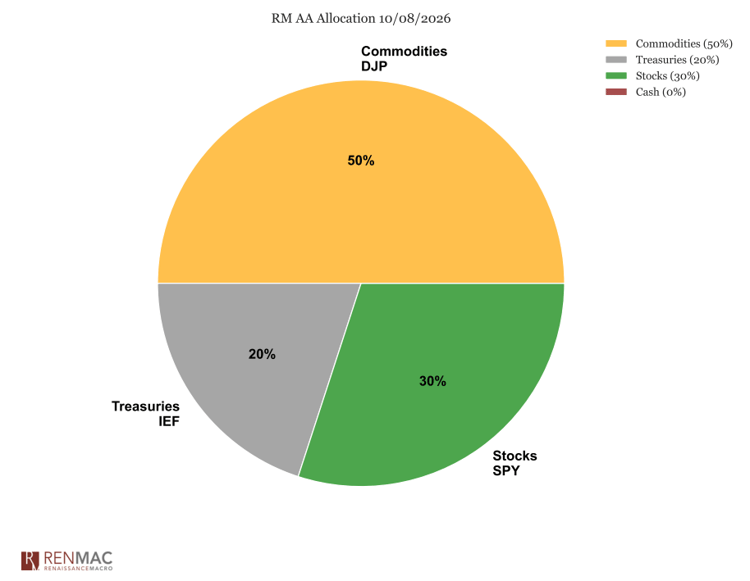
- Our commodity weights are running hot. This is a function of the market cycle clock which remains embedded in the weakest equity return zone and high nominal rates. Those not comfortable with commodity exposure should replace the allocation with cash exposure. A bull flattener in the 2s – 10s yield curve will suggest the commodity bull market is becoming vulnerable.
Economics
- Waller has turned meaningfully more hawkish, narrowing the gap with Warsh even while maintaining the case for no October hike.
- He now emphasized stronger growth, persistent core inflation around 2.5%-3.0%, and the risk that inflation expectations drift higher after more than five years above target,
- His discussion of potentially signaling 75bps of hikes over six months implies October is more likely a pause than an endpoint.
- At a minimum, December and March hikes remain likely, with January also in play if the Fed raises its inflation forecast again.
- Some of the apparent early-year inflation heat reflects residual seasonality rather than underlying price pressure. We estimate it added roughly 0.4ppt to annualized core inflation in Q1 2026.
- Adjusting for that effect, core PCE looks closer to 3.4% than 3.9%, while core CPI looks closer to 2.4% than 2.8%.
- The distribution is borrowed, not permanent: it tends to make inflation look hotter early in the year and softer later, netting to zero over the full year.
- The wrinkle is that the effect has not yet faded this cycle. For now, we would shade first-quarter core inflation down by roughly a third of a point and avoid overreacting to a hot Q1 print alone.
- Survey-based inflation expectations are moving higher, reinforcing the Fed's concern that persistent above-target inflation could become more entrenched.
- The NY Fed's one-year consumer inflation expectations rose to 3.9%, the highest since May 2023, while Atlanta Fed business unit-cost expectations climbed to 2.4%.
- If anchoring inflation expectations helped justify September's hike, that rationale remains firmly in place.
- The trade deficit widened sharply in August to $105.6 billion, as imports surged 4.3% to a record $420.8 billion while exports rose only modestly.
- The widening was driven largely by crude oil, gold and capital-goods imports, with semiconductor imports up $2.4 billion as the AI buildout continues to rely heavily on foreign supply.
- Exports looked softer beneath the headline, while the ex-petroleum deficit reached its widest level of the year.
- With the three-month trade deficit running materially wider than a year ago, net exports are likely to subtract meaningfully from Q3 growth.
- Small firms using AI are more optimistic on hiring and revenue, with AI adopters showing materially stronger expectations than non-users.
- The gap persists even after controlling for firm characteristics and past performance, and is largest among financially weaker firms, suggesting AI may be helping patch operational gaps rather than simply reflecting optimism.
- The key caveat is that these are expectations, not realized outcomes. Still, with little evidence of lower labor costs or worker displacement, AI adoption on Main Street currently looks more growth-oriented than labor-replacing.
 Sector Ranks
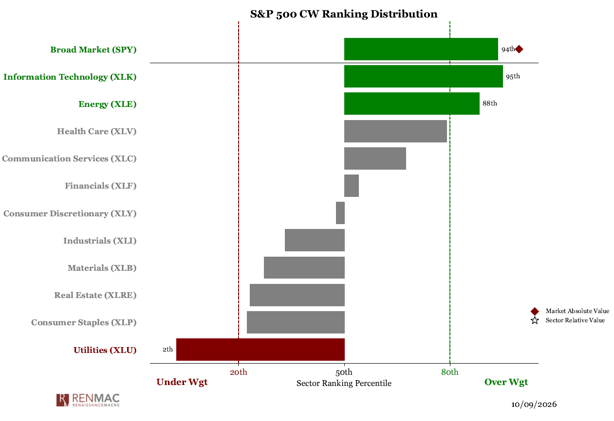 Chart of the week
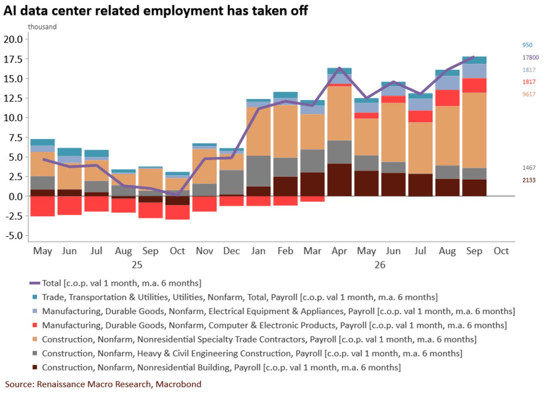
The AI data center and investment boom is bleeding into employment. Nonresidential specialty trade contractors, computer & electronics manufacturing, power generation & supply, etc. A year ago this was running flat and now, it is adding almost 20k payroll jobs per month.
RenMac Off-Script Podcast

RenMac Calendar
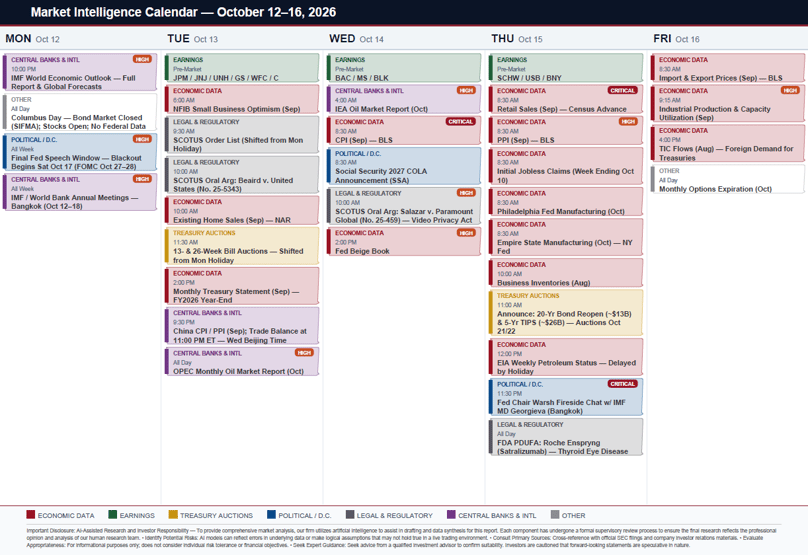
Research Notes
Economics
- US labor market continues its downtrend. Weekly job postings continue to trend down, layoffs picking up, quits are cooling.
- March data showed broad economic weakness, with declines in services, confidence, housing, and commercial real estate.
- Rising inflation, weakening job outlooks, and cautious business spending point to growing economic strain.
- Home prices are cooling, which may curb spending as household wealth dips and the savings rate edges higher.
- The rebound in capital goods shipments looks fragile, with growth mostly tied to tech and broader investment plans weakening.
- New tariffs could cut 0.5% from GDP, strain trade ties, and raise car prices before production shifts take effect.
- Auto repossessions are at their highest since 2009, and tariffs may push buyers to the used market, keeping prices elevated.
- Despite trade tensions, signs of de-escalation and strong profits offer some cushion, with markets already pricing in much of the downside.
- Q4 growth was lifted by consumer and government spending, but with investment falling and key supports fading, a broader slowdown seems likely.
Strategy
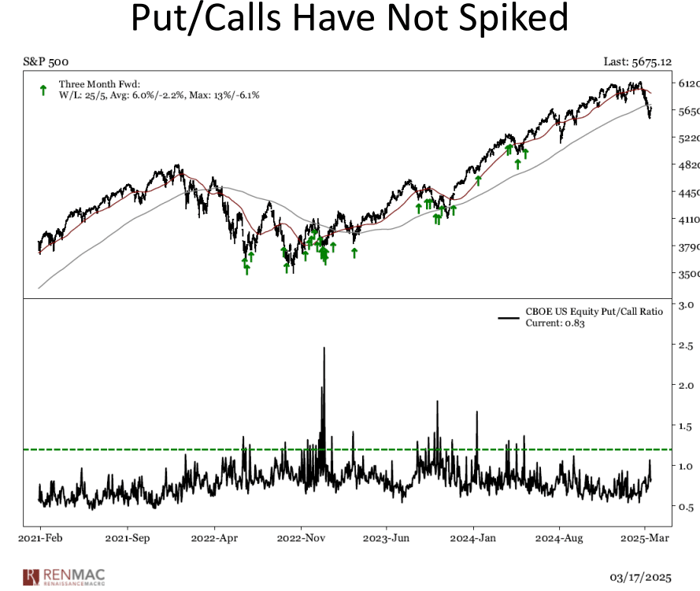
- Market technicals show potential for a rebound. We think Mag7 approaches 50dma and potentially crosses through, getting to overbought, high beta stocks slowly recovering, and excessive outflows in IWM and SPY could fuel a tactical bounce.
- Remember, this was a beta-driven correction, not a momentum-driven one.
- Remember, this was a beta-driven correction, not a momentum-driven one.
- Bullish signals may re-emerge if a high percentage of stocks move about their 20dma and hit 20-day highs, suggesting a reassertion of the bull trend.
- Despite heightened policy uncertainty and a dark cross in tech, strong credit markets and sentiment tied to returns suggest the current pessimism may be overdone.
- Semi's continue to weaken, with even "good" ones coming under pressure.
- Staples pulled back at resistance levels, maintaining relative downtrend. Sharp unwind in beta and extreme underperformance suggests continued downward pressure.
- Transports reiterate bearish trend but flagging oversold and in "seller's frenzy". Expect short-term tactical bounce but fade the move.
Policy
- Debt limit deadline ("X-Date") likely between July and October, with resolution hinging on reconciliation or bipartisan deal amid uncertain cash flows.
- Delays risk market volatility and a Moody's downgrade, raising U.S. borrowing costs.
- Delays risk market volatility and a Moody's downgrade, raising U.S. borrowing costs.
- Trump will announce reciprocal tariffs on April 2, targeting about 15 key partners; recent moves on oil, autos, and threats to the EU and Canada may be strategic leverage.
- Section 232 is being used more broadly to justify tariffs on national security grounds, covering autos, copper, timber, and pharma, with an emphasis on U.S. production.
- Tariff timing and scope remain unclear, with Trump using them as a flexible tool, adding to market uncertainty.
Asset Allocation Model
 Sector Ranks
 Chart of the week
Sector Ranks Chart of the week