Research Notes
Strategy
- Bull vs Bear figures were little changed week over weak suggesting returns still have room to suck people into equities before disappointing.
- Sentiment is better at a bottom than a top, but in fairness, it’s usually more robustly bullish near tops than where we are today.
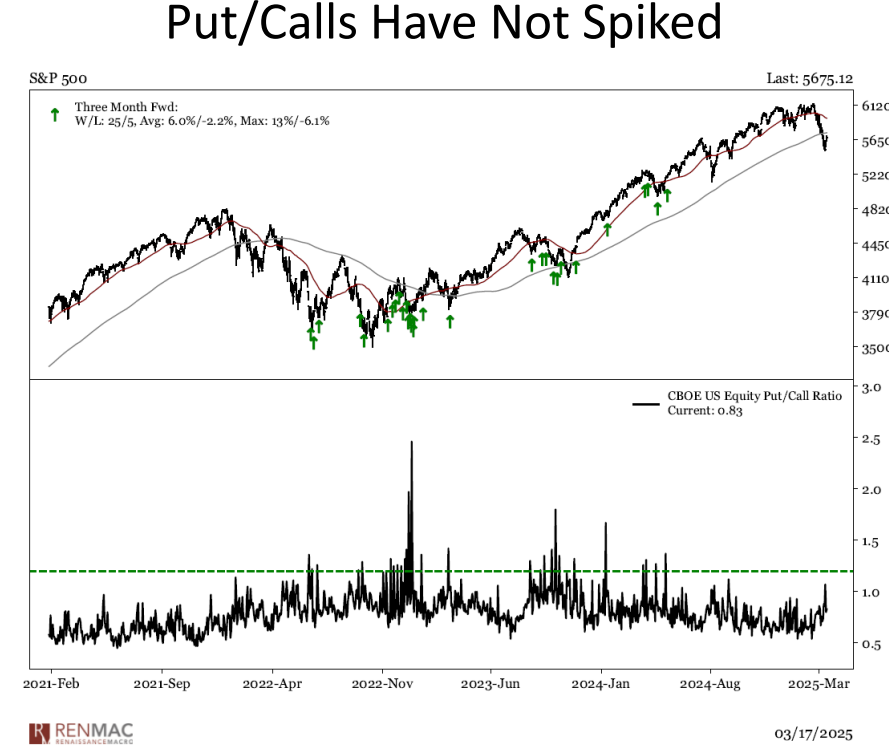
- Put/Call ratios are hovering near multi-year lows as option players position for upside. It’s not obvious in surveys like the I.I. bull vs bear ratio from Wednesday’s daily or even the Consensus Inc. data, but animal spirts are present.
- Curiously the % of issues above their 20-day moving average has been in decline for several days and is now hovering around 50%. That’s not a momentum number, that’s an oddity, and confirms the lack of 20-day highs this market has presented us with since the lows at the end of March.
- We’re not huge fans of Dow Theory, we like the concept, don’t like the back-tests since 1980s. With that, the DJTA had a violent round-trip: 24,000+ to 20,000, and that price action tells us the move was short-covering and macro-tourist, not steady accumulation.
- Equal-weight transports tells a different story: still trending, more contained, sitting on a clean 200-DMA with the relative line breaking out.
- When the cap-weighted breaks and the equal-weighted doesn't, the message is the breadth is intact; the noise is in index construction. Don't extrapolate the DJTA's wild ride to the whole transport thesis.
- KOSPI has joined the SOX in our bubble framework after doubling over a two-year window for the first time since the 1980s, with Taiwan close behind and U.S. tech benchmarks not far off.
- Bubble signals are warning flags, not signals. Momentum can persist longer than expected, making premature shorts costly.
- The playbook remains: stay with the trend, gradually reduce risk as conditions deteriorate, and exit on the break rather than on valuation alone.
- Click here for a video from deGraaf diving into this
- Pharma’s improvement is looking more entrenched, particularly as life-science and equipment names fail to find a toe-hold. The relative performance of R1000 pharma has clearly turned higher after years of neglect and have ample run-way in our SERM work to extend the rally.
- Bitcoin has managed to claw its way back to the descending 200-day moving average. That happens to coincide with overhead resistance levels from 4Q 2025. It’s not overbought yet, and we’ll use an overbought condition to set-up another short position to exploit the downtrend.
Economics
- April's employment report doesn't change much, but it's a reminder that left-tail risks around the labor market have been clipped. Conditions have improved from where we started the year, which means the Fed can keep its focus on prices.
- Private payrolls rose 115k in April after 185k in March, the best 6 month run since last April.
- The data center buildout is showing up in the mix. Nonresidential construction employment rose 18,200, the fastest in 3 months, and the durable goods workweek hit 40.7 hours, the highest since March 2025.
- Residential construction is still bleeding, and information, financial activities, and accommodation services all softened.
- Wage growth is cooling, which is probably what the bond market is latching onto. Average hourly earnings rose 0.2% for the second straight month. The 3m/3m pace is just 3.1% annualized. Unemployment ticked up to 4.34%, U6 jumped to 8.2%, and prime-age employment held flat at 80.7%
- The story going forward is how income and spending reconcile. Aggregate weekly payrolls are up 4%, nominal GDP is running 6%. If income is cooling into higher prices, consumers slow down. That eventually feeds back into hiring.
- Private payrolls rose 115k in April after 185k in March, the best 6 month run since last April.
- The standard pushback on the AI-is-juicing growth view is that, net of imported semis, the direct GDP contribution looks small. That misses how far the AI capex cycle has spread into the rest of the equity market.
- 15 non-tech S&P 500 names, worth about $2T combined, now trade with the semi ETF at a daily correlation of 0.5 or higher. 12 are industrials. Caterpillar, Vertiv, Eaton, Cummins, GE Vernova. They aren't tech stocks. They trade like semis because their order books have become AI capex order books. The 6-month correlations are tighter than the 1-year, so the linkage is strengthening, not fading.
- The flip side is just as striking. Roughly $11T of the index, 15% of the market cap, has a negative correlation with semis. Utilities, staples, P&C insurance, telecom, waste. The market is actively rotating out of these names when AI rallies, not just ignoring them.
- Productivity slowed in Q1 to 0.8% annualized, pulling the two-quarter pace down to 1.2%.
- Unit labor costs are up 1.2% YoY, so no inflation impulse from the labor side.
- Prices are still running ahead of those costs, which points to margin expansion.
- But there are two kinds. One comes from stronger productivity, and the other comes from compensation slowing faster than prices. Q1 was more of the latter. That's the late-cycle version, not the durable one.
- Initial claims rose 10k to 200k last week, a touch below the 205k consensus. The level isn't the story, the trend is. Initial claims have now run below their year-ago pace for 12 straight weeks.
- Continuing claims fell to 1.77 million, about 6% below the comparable week last year, and the upward drift we saw through last summer has cleanly broken.
- Bank credit is still skewed restrictive and demand cooled. The net share of banks tightening C&I standards to large and middle-market firms picked up to 8.1%. Despite a booming stock market and tight credit spreads, banks haven't net-eased C&I standards to bigger borrowers since Q2 2022. Demand softened too, slipping to 4.8% from 16.1% in the prior release.
- CRE was mixed on standards but cleaner on demand. A net 11.7% of banks reported weaker demand for construction loans, a sharp reversal. Lenders will still underwrite stabilized properties, but appetite for new construction has faded.
- Consumer standards were basically unchanged, but demand softened across mortgages, credit cards, and autos. HELOCs were the only bright spot. Standards still aren't easing, and demand is rolling over.
 Sector Ranks
  Chart of the week
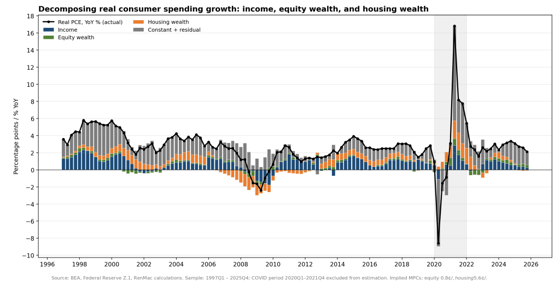
Consumption isn't well supported by income anymore. Over the last four quarters, real PCE ran more than twice the pace of real disposable income. Outside the post-pandemic snapback, you only see that kind of gap at the peak of the late-90s tech boom and the mid-2000s housing boom. Income contributed just 0.4 percentage points to real PCE growth, the weakest non-recession reading in the sample. Equity wealth did most of the rest. That's the most equity-dependent mix outside a recession. The wealth effect is real, but it depends more and more on what the top decile decides to do.
RenMac Off-Script Podcast

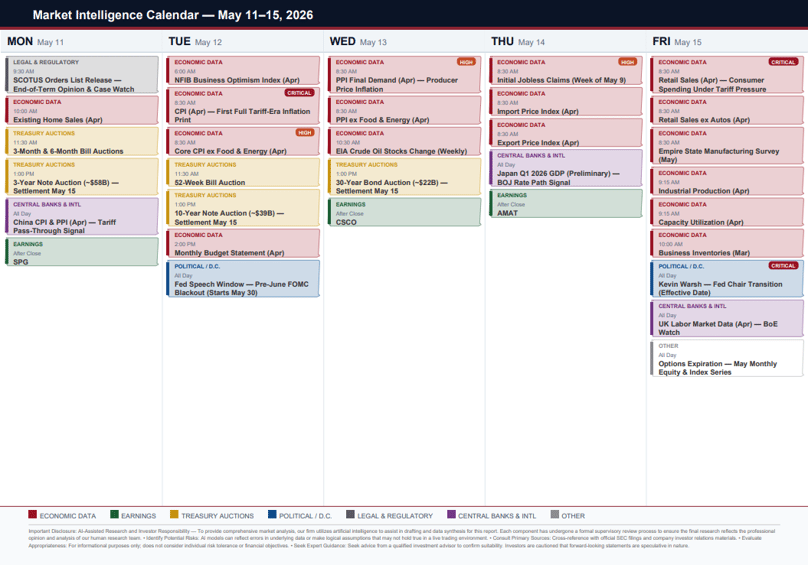
RenMac Calendar
Research Notes
Economics
- US labor market continues its downtrend. Weekly job postings continue to trend down, layoffs picking up, quits are cooling.
- March data showed broad economic weakness, with declines in services, confidence, housing, and commercial real estate.
- Rising inflation, weakening job outlooks, and cautious business spending point to growing economic strain.
- Home prices are cooling, which may curb spending as household wealth dips and the savings rate edges higher.
- The rebound in capital goods shipments looks fragile, with growth mostly tied to tech and broader investment plans weakening.
- New tariffs could cut 0.5% from GDP, strain trade ties, and raise car prices before production shifts take effect.
- Auto repossessions are at their highest since 2009, and tariffs may push buyers to the used market, keeping prices elevated.
- Despite trade tensions, signs of de-escalation and strong profits offer some cushion, with markets already pricing in much of the downside.
- Q4 growth was lifted by consumer and government spending, but with investment falling and key supports fading, a broader slowdown seems likely.
Strategy
- Market technicals show potential for a rebound. We think Mag7 approaches 50dma and potentially crosses through, getting to overbought, high beta stocks slowly recovering, and excessive outflows in IWM and SPY could fuel a tactical bounce.
- Remember, this was a beta-driven correction, not a momentum-driven one.
- Remember, this was a beta-driven correction, not a momentum-driven one.
- Bullish signals may re-emerge if a high percentage of stocks move about their 20dma and hit 20-day highs, suggesting a reassertion of the bull trend.
- Despite heightened policy uncertainty and a dark cross in tech, strong credit markets and sentiment tied to returns suggest the current pessimism may be overdone.
- Semi's continue to weaken, with even "good" ones coming under pressure.
- Staples pulled back at resistance levels, maintaining relative downtrend. Sharp unwind in beta and extreme underperformance suggests continued downward pressure.
- Transports reiterate bearish trend but flagging oversold and in "seller's frenzy". Expect short-term tactical bounce but fade the move.
Policy
- Debt limit deadline ("X-Date") likely between July and October, with resolution hinging on reconciliation or bipartisan deal amid uncertain cash flows.
- Delays risk market volatility and a Moody's downgrade, raising U.S. borrowing costs.
- Delays risk market volatility and a Moody's downgrade, raising U.S. borrowing costs.
- Trump will announce reciprocal tariffs on April 2, targeting about 15 key partners; recent moves on oil, autos, and threats to the EU and Canada may be strategic leverage.
- Section 232 is being used more broadly to justify tariffs on national security grounds, covering autos, copper, timber, and pharma, with an emphasis on U.S. production.
- Tariff timing and scope remain unclear, with Trump using them as a flexible tool, adding to market uncertainty.
Asset Allocation Model
 Sector Ranks
  Chart of the week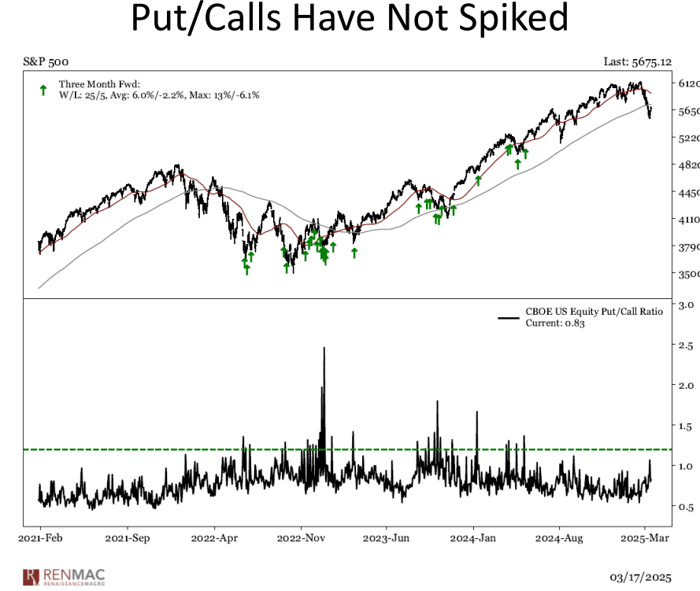
Sector Ranks Chart of the week