Research Notes
Strategy
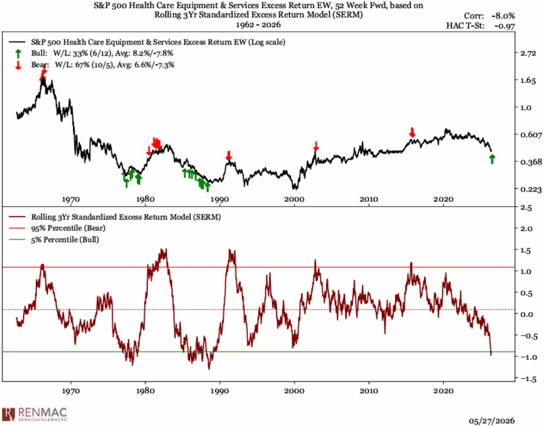
- We apply our SERM work to industries and sectors to better understand how much excess returns has developed and to guard against "buy-in" at a point that history suggests sobriety, and we can apply this logic to other relationships such as intra-sector relationships.
- When applied to Tech vs Healthcare, it is particularly note-worthy as the SERM differential is now in the 95th percentile in the last 60ish years.
- While the t-stats confirm a negative relationship to forward returns, they are not significant, but there is economic significance out 12-months.
- We think about this within the context of sources and uses of funds when reallocating gains from tech and suggest looking at the emerging bases in healthcare.
- As Chancellor reminds us in "Devil Take the Hindmost", capital chases the parabola until there is nothing left to chase, then it goes looking for the rooms nobody wants to sit in, and for years that room has been Health Care.
- We've seen positive volatility alerts across Pharma, Biotech & Life Sciences clustering.
- EW Health Care Providers has flipped bullish. Even Life Science tools, still in a downtrend, is throwing off positive surprises down at the lows... often a tell that sellers are exhausted.
- Crude's continued decline sparked discretionary names to lead Wednesday's tape. Instead of being reactionary and looking for turns, we'd be buying leaders in the space versus the hope trade such as homebuilders who have rallied back into resistance.
- Polymarkets are pricing in lower crude oil, setting expectations and creating mispricing if negotiations stall or a sell the news event if a breakthrough develops.
- They are not there yet, but we believe a news driving break in energy names that pushes them into an oversold condition is likely a contrarian buy.
- They are cheap in our work, have solid trends, big base formations and are considered relics of a by-gone era.
- The contraction in yields has quickly moved our impact model into the 80th percentile on 10-year yields as consumer confidence figures marinate in the lowest historical decile.
- We don’t like private credit, and real yields need to contract and flip places with inflation expectations as far as dominance in yield attribution is concerned for improved health and sustained advance.
- Collectively, they need to soften our Yield Impact Model from the top deciles to something a little more friendly for equities.
- If real yields contract faster than inflation expectations, the oversold condition in banks and the ETF outflows make that an attractive area for reversion and a rally higher.
- REITs are also making 52-week highs but not yet confirming in our relative strength work. There are opportunities in industrial, health care and retail REITs.
Economics
- April core PCE rose 0.24%, a touch below our 0.28% estimate. That's a step down but still consistent with 2.9% annualized inflation, well above target. The print got help from portfolio management services as stocks fell. Market-based core PCE rose 0.29%, and the recent equity rebound will bleed back in through the rest of Q2.
- Housing's contribution has largely normalized. The gap to target is in core goods and non-housing services. With tariff effects fading, core goods should ease from here.
- Core services ex-housing is the sticky problem and remains firm even as wage growth has cooled. That's a communications pickle for the Fed. Labor cost pressures have eased while the PCE measure meant to capture them has not. The hawks will read this as a warning that expectations are drifting up.
- Income growth is deteriorating. Personal income was flat in April with a downward revision to March. Wages and salaries rose just 0.2% and are up 3.5% YoY. It's usually not a good sign when wages are running below the fed funds rate. Real personal incomes ex transfers fell 0.4%, the fourth decline in five months and down 1.8% over the last six.
- The consumer is running on fumes. Nominal consumption rose 0.5% in April, but real spending was up just 0.1% after backing out PCE inflation. Now that tax refunds are exhausted and gas prices remain elevated, spending looks increasingly at risk.
- The personal savings rate fell 0.6 points to 2.6%, a 1.7 point drop over the last three months, historically very large. Incomes may eventually get revised up, but the speed of this decline is concerning. A consumption burst fueled by lower savings is not the same as one fueled by rising income.
- The Conference Board's CEO Confidence Index fell to 47 in Q2, the lowest in a year and back below the 50 neutral line. Current conditions dropped 17 points and expectations fell 11. Whatever enthusiasm there was for a reacceleration has evaporated.
- Hiring is softening. 31% of CEOs plan to reduce headcount, up from 27% in Q1, and that's now higher than the 28% planning to expand. Capex plans held up better.
- CEO Confidence has historically tracked corporate profits reasonably well, though the relationship has been spotty lately.
- The Conference Board's Consumer Confidence Index slipped 0.7 to 93.1 in May. The present situation hit a 3-month low at 121.2 while expectations rose to 74.4, the highest this year.
- The Labor Market Differential eased to 6.9, driven by fewer respondents calling jobs plentiful. Buying conditions softened for both autos and homes.
- The expectations gain is being driven by stocks. The net share of consumers expecting higher equity prices over the next 12m jumped to 29.9%, the highest this year. What's unusual is that consumers are more cautious on jobs even as they're bullish on stocks.
- New home sales fell 6.2% in April to a 622k annualized pace, down 11.3% YoY. The pullback was broad, led by a 25% drop in the Midwest and a 9.8% drop in the South. The West was the lone gainer at 18.7%.
- Inventory pressure intensified. Months' supply climbed to 9.4 from 8.7. Completed homes are sitting longer, and the share of for-sale inventory not yet started has risen to 23%.
- Purchase loan demand has been essentially flat YTD, a sign higher rates have been weighing on housing market activity. In the four week period ending May 22, purchase applications slid 4.5% as the 30Y FRM has increased 28bps.

Research Notes
Economics
- US labor market continues its downtrend. Weekly job postings continue to trend down, layoffs picking up, quits are cooling.
- March data showed broad economic weakness, with declines in services, confidence, housing, and commercial real estate.
- Rising inflation, weakening job outlooks, and cautious business spending point to growing economic strain.
- Home prices are cooling, which may curb spending as household wealth dips and the savings rate edges higher.
- The rebound in capital goods shipments looks fragile, with growth mostly tied to tech and broader investment plans weakening.
- New tariffs could cut 0.5% from GDP, strain trade ties, and raise car prices before production shifts take effect.
- Auto repossessions are at their highest since 2009, and tariffs may push buyers to the used market, keeping prices elevated.
- Despite trade tensions, signs of de-escalation and strong profits offer some cushion, with markets already pricing in much of the downside.
- Q4 growth was lifted by consumer and government spending, but with investment falling and key supports fading, a broader slowdown seems likely.
Strategy
- Market technicals show potential for a rebound. We think Mag7 approaches 50dma and potentially crosses through, getting to overbought, high beta stocks slowly recovering, and excessive outflows in IWM and SPY could fuel a tactical bounce.
- Remember, this was a beta-driven correction, not a momentum-driven one.
- Remember, this was a beta-driven correction, not a momentum-driven one.
- Bullish signals may re-emerge if a high percentage of stocks move about their 20dma and hit 20-day highs, suggesting a reassertion of the bull trend.
- Despite heightened policy uncertainty and a dark cross in tech, strong credit markets and sentiment tied to returns suggest the current pessimism may be overdone.
- Semi's continue to weaken, with even "good" ones coming under pressure.
- Staples pulled back at resistance levels, maintaining relative downtrend. Sharp unwind in beta and extreme underperformance suggests continued downward pressure.
- Transports reiterate bearish trend but flagging oversold and in "seller's frenzy". Expect short-term tactical bounce but fade the move.
Policy
- Debt limit deadline ("X-Date") likely between July and October, with resolution hinging on reconciliation or bipartisan deal amid uncertain cash flows.
- Delays risk market volatility and a Moody's downgrade, raising U.S. borrowing costs.
- Delays risk market volatility and a Moody's downgrade, raising U.S. borrowing costs.
- Trump will announce reciprocal tariffs on April 2, targeting about 15 key partners; recent moves on oil, autos, and threats to the EU and Canada may be strategic leverage.
- Section 232 is being used more broadly to justify tariffs on national security grounds, covering autos, copper, timber, and pharma, with an emphasis on U.S. production.
- Tariff timing and scope remain unclear, with Trump using them as a flexible tool, adding to market uncertainty.
Asset Allocation Model
 Sector Ranks
  Chart of the week
Sector Ranks Chart of the week