Research Notes
Strategy
- MoM CPI readings are well in the top 10th percentile in our work and carry a -2.47 t-stat to 6m S&P forward returns.
- Inflation readings are far more deleterious to SPX returns than growth, and Tuesday's data reinforces what our market cycle clock tells us historically, "inflation is a headwind for SPX returns".
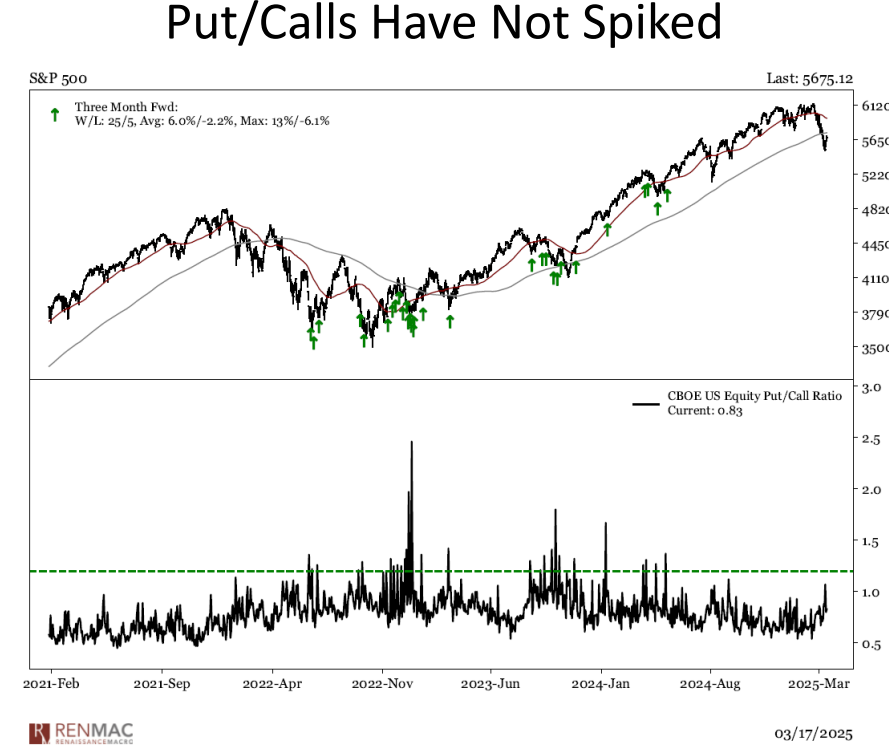
- The bull vs bear spread in the middle latitudes is not telling us much, if anything there appears more room for people to structurally buy into the advance. It sits in admitted conflict with Put/Call ratios, but an important condition for sentiment to be effective is consistency across various players.
- If the option players are bullish, but newsletter writers are non-committal, sentiment is likely to be less influential than when the majority are fishing from the same side of the proverbial boat.
- Index option skew has reached its lowest level in over a year. This is a classic example of precision versus accuracy in our business.
- Relying on precision, while seductive, is a loser's game in this business while not requiring bulls-eyes but just trying to hit the target is usually good enough and a better long-term outcome vs an unattainable goal.
- The difference between upside and downside pricing is at a low level that implies a high degree of confidence in the future.
- That's consistent with put/call readings, but not with the broader sentiment environment.
- SLV ETF flows remain bearish while GLD flows are middling. The difference is in price, where SLV made a 20- day high and continues to look more bullish with the industrial metals while GLD struggles under its own 50- day moving average. We’re philosophical gold bulls, but like the technical set-up in copper and silver better.
- The memory cycle's 30-year history suggests that while demand narratives evolve, pricing durability rarely does, and with Micron and SK Hynix margins at record highs, mean reversion risk is rising.
- Today's overheating IPO backdrop, including massive oversubscription around deals like Cerebras and a potential SpaceX-led 2026 supply wave, echoes the classic late-cycle "party phase" seen near prior peaks.
- The takeaway is not to fight the trend, but to recognize the setup: record margins + record supply have historically marked cycle tops, favoring a strategy of riding the strength while gradually de-risking into it.
- Watch a video from Jeff on this
Economics
- 10Y yields fell following last Friday's employment report and hardly budget after the CPI data. May 15 however, 10yr yields are climbing. At least two factors are at play.
- First, President Trump suggested the US doesn't need the Strait of Hormuz open "at all", predictably causing an oil price rise which seeps into inflation.
- Second, producer prices in Japan rose nearly 3x worse than expected, sending JGB yields through the roof. So, to some extent, global fixed income is losing an anchor as JGB yields shoot higher.
- Last year, when bond yields shot up, President Trump pivoted and paused his reciprocal tariff policy, but today he is not as concerned about making sure the bond market is "beautiful". No pivot on the Strait seems likely now.
- A common thing we hear is that if AI ever crashed, bond yields would fall, but we question how much if they are being pushed up by term premium effects.
- Yields are up all over the world. If falling term premiums were a tailwind for equities, higher term premiums are a headwind now.
- Lastly, we've seen a large jump in earnings expectations in recent weeks. There is probably less room for earnings estimates to rise at this point, which implies more room for rates to move stock prices.
- Headline CPI rose 0.6% in April after 0.9% in March. With wage growth this sluggish, real incomes are getting squeezed. Our proxy for real labor income has contracted 3.7% annualized over the last three months.
- Core CPI rose 0.4%, but the print was driven by a 6.6% annualized jump in housing rental inflation. Most of that is a delayed correction from the October shutdown, when the BLS had to assume unchanged prices. The broader story is that rents are still cooling.
- Core-CPI ex-shelter rose just 0.19%, running 2.16% over the last 3 months. Core goods were flat, the weakest print of the year. Vehicle prices fell 0.16%. Apparel keeps grinding higher.
- Software prices surged another 5%. Lodging away from home jumped 2.44%, which is hard to square with industry data. Menu price growth has slowed to 3.6% YoY, the slowest since January 2025, which reflects cooler labor.
- For equities, the takeaway is higher energy prices eroding purchasing power. For bonds, April core PCE looks a touch better than March but still around 0.25% over the month, a full point above target.
- None of this changes the momentum behind a hawkish shift in the FOMC's statement.
- April PPI extends the run for the policy hawks. Translating PPI and CPI into core PCE, we estimate 0.28% MoM, or 3.4% annualized. That's five straight months of core inflation above 3%. There's plenty of room for the Fed to revise up its 2026 core PCE estimate at the June meting from the current 2.7%.
- A few things stood out. The drag from portfolio management fees will reverse in the coming months as equity prices feed back through. Jet fuel is bleeding into airfares, with the scheduled domestic passenger air transportation index up 3% on the month and 15% YoY.
- Inflation is moving away from target while unemployment is on target. Central bankers really only move in one direction when the data looks like this. This isn't a positive setup for risk assets. Cuts will come under a much weaker set of earnings conditions. Hikes are kept at bay only because weaker real incomes are bleeding into weaker output.
- Retail sales rose 0.5% in April, but after adjusting for prices not much is happening. Real spending was up just 0.1 point. Dollars are getting spent, but not much stuff is getting bought. Clothing sales fell 1.5% as apparel prices jumped 0.6%. Food and beverage sales rose 0.8% but prices were up 0.7%.
- Food services and drinking places were a bright spot, up 0.6% for a third straight month, though nominal spending is barely up 3% YoY.
- The setup for households is getting harder. Tax refunds offset some of the gasoline squeeze. With refund season and gas prices still elevated, the risk is a backloaded spending slowdown in Q2.
 Sector Ranks
 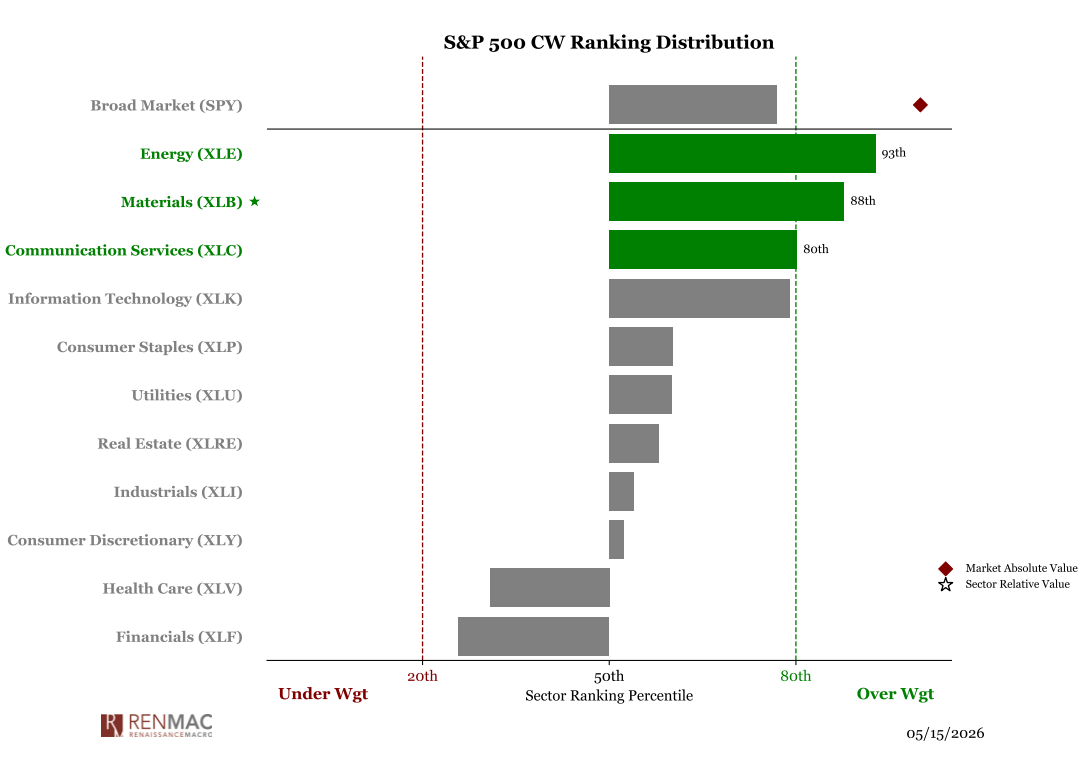 Chart of the week
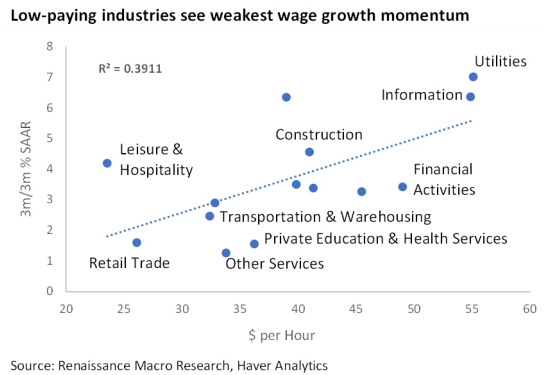
The Fed is on a glidepath to drop its easing bias. With equities surging and labor market conditions stable to slightly better, the FOMC can focus entirely on prices. Neil doesn't think they end up hiking, but the bias will move that way. Private payrolls excluding healthcare have rebounded and unemployment has been flat for nearly a year. Credit spreads are tight and a financial conditions model implies above-trend growth. That said, the downside risks are there. Aggregate labor incomes aren't strengthening even as consumer prices climb, which is a recipe for weaker real consumption and eventually weaker hiring. Wage growth is slowest in the lowest-paying industries. Housing-related employment keeps sliding, and credit conditions for consumers still aren't easing. It's unusual to see a major labor market rebound from this setup.

Research Notes
Economics
- US labor market continues its downtrend. Weekly job postings continue to trend down, layoffs picking up, quits are cooling.
- March data showed broad economic weakness, with declines in services, confidence, housing, and commercial real estate.
- Rising inflation, weakening job outlooks, and cautious business spending point to growing economic strain.
- Home prices are cooling, which may curb spending as household wealth dips and the savings rate edges higher.
- The rebound in capital goods shipments looks fragile, with growth mostly tied to tech and broader investment plans weakening.
- New tariffs could cut 0.5% from GDP, strain trade ties, and raise car prices before production shifts take effect.
- Auto repossessions are at their highest since 2009, and tariffs may push buyers to the used market, keeping prices elevated.
- Despite trade tensions, signs of de-escalation and strong profits offer some cushion, with markets already pricing in much of the downside.
- Q4 growth was lifted by consumer and government spending, but with investment falling and key supports fading, a broader slowdown seems likely.
Strategy
- Market technicals show potential for a rebound. We think Mag7 approaches 50dma and potentially crosses through, getting to overbought, high beta stocks slowly recovering, and excessive outflows in IWM and SPY could fuel a tactical bounce.
- Remember, this was a beta-driven correction, not a momentum-driven one.
- Remember, this was a beta-driven correction, not a momentum-driven one.
- Bullish signals may re-emerge if a high percentage of stocks move about their 20dma and hit 20-day highs, suggesting a reassertion of the bull trend.
- Despite heightened policy uncertainty and a dark cross in tech, strong credit markets and sentiment tied to returns suggest the current pessimism may be overdone.
- Semi's continue to weaken, with even "good" ones coming under pressure.
- Staples pulled back at resistance levels, maintaining relative downtrend. Sharp unwind in beta and extreme underperformance suggests continued downward pressure.
- Transports reiterate bearish trend but flagging oversold and in "seller's frenzy". Expect short-term tactical bounce but fade the move.
Policy
- Debt limit deadline ("X-Date") likely between July and October, with resolution hinging on reconciliation or bipartisan deal amid uncertain cash flows.
- Delays risk market volatility and a Moody's downgrade, raising U.S. borrowing costs.
- Delays risk market volatility and a Moody's downgrade, raising U.S. borrowing costs.
- Trump will announce reciprocal tariffs on April 2, targeting about 15 key partners; recent moves on oil, autos, and threats to the EU and Canada may be strategic leverage.
- Section 232 is being used more broadly to justify tariffs on national security grounds, covering autos, copper, timber, and pharma, with an emphasis on U.S. production.
- Tariff timing and scope remain unclear, with Trump using them as a flexible tool, adding to market uncertainty.
 Sector Ranks
  Chart of the week