Research Notes
Strategy
- Momentum has hit an extreme and started to contract. The S&P's 3m momentum sits in the 92nd percentile and is rolling over from a near-record high. The vulnerable point isn't just reaching the 90th percentile, it's reaching it and then turning down. Looking at the factor going back to 1958, these episodic peaks have a way of fizzling out.
- Momentum used to have a persistent factor bias. Buy what's up, sell what's down, and you got paid. That shifted after 2010, possibly thanks to QE.
- The contraction is already playing out in industrials, which have gone from the 90th percentile to the 70th. Tech is starting to follow but is still in the 98th percentile, which tells you how excessive it was to begin with. Software is the one area starting to improve.
- The crypto carnage extended this week, with Bitcoin near its February lows of ~60k and the Grayscale Ethereum ETF, ETHE, falling to a fresh 18-month low.
- While bearish sentiment in crypto is already extreme, large topping patterns continue to point to further downside risk. We would use rallies as opportunities to rotate out, as we believe the low-$50k's are in play for Bitcoin.
- Additionally, we now see crypto diverging with the NDX and being oversold. These conditions are a feature of downtrends, not a buy point.
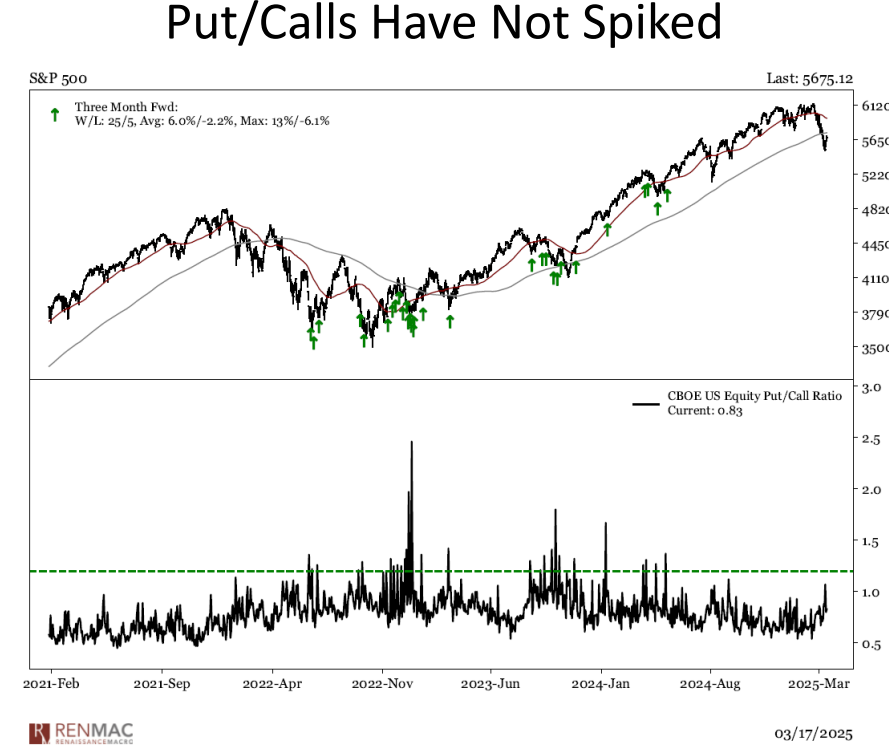
- Tuesday closed at a new SPX high, but the tape is starting to pay for its confidence the way it usually does by not paying for insurance. Our 3m skew had a dark-cross Tuesday, a developing complacency reading consistent with put-call ratios that says the marginal dollar is reaching for upside rather than protecting the downside.
- Those are bricks falling out of the wall of worry, not collapsing, not a fire alarm, a yellow flag that tells us the cushion is thin. Enjoy it, know where the exits are, and we'll be your sober driver to get you home.
- The likely inclusion of SpaceX into Communications Services is bound to add some volatility to the sector. AT&T is already feeling the pressure of Starlink as it made a new 52wk relative low Wednesday.
- Elsewhere in the sector, GOOGL is now oversold on our oscillator and looks buyable after a 12% correction from the high. But others like NFLX, META and DIS continue to look vulnerable as they carve out big topping patterns.
- We flagged the big, slow healthcare turn into late May, and the deck is now filling in with the confirmation rather than the thesis. Managed Care fired a positive volatility alert off a year-long shelf. Pharma, biotech and life-science tools are at new highs in equal-weight terms.
- Our biotech flows model still reads excessive outflows, a 10th percentile setup that has historically been a tailwind, not a warning.
- This is the bubble-breadth mechanic in plain sight: when the air gets sucked out of one parabolic corner, it doesn't vanish, it gets sucked into the rooms nobody wanted.
Economics
- The labor market has kicked into a higher gear. Jobs growth was solid in May and prior months got revised up sharply. The Fed debate is shifting. The easing bias drops later this months. A tightening bias could come as soon as July.
- Equities are treating good news as bad news, a knee-jerk reaction to higher rates. If the Fed is hiking because employment is expanding, that's not necessarily bearish for stocks. Stagflation is bad for equities. An inflationary boom is not.
- If the next move is a hike, it's likely 75bps, which would unwind last year's insurance cuts. The Fed never goes just once. Pressure on the front end of the curve continues.
- Underneath, private payrolls have averaged 166k over the last 3m. Goods-producing jobs jumped 28k led by construction. Services added 92k led by leisure, hospitality, and healthcare. Wage growth has actually been restrained at 2.8% annualized over the last 3m and 3.4% YoY.
- The wrinkle is that the breakeven rate on employment may not be as low as the Fed assumes. 3 months of payroll growth with unemployment flat at 4.3% and wage growth at just 2.8% annualized doesn't obviously call for tighter policy.
- The decline in the saving rate has gotten a lot of attention, but I don't assume a bad outcome just because the level is historically low. The saving rate is notorious for getting revised up as incomes get found later. The Flow of Funds version, which adds up assets net of new borrowing, shows a much bigger cushion than the residual measure everyone cites.
- The decline also makes sense given the rise in net worth relative to income. Households see asset price gains as a low-risk form of income creation, so savings rates fall. The net worth to income ratio is near a record high while the saving rate is near its lows.
- The risk worth noting is the speed of the decline, 1.7 points in three months, which looks more cyclical than structural. If consumers are drawing down savings to cushion a temporary gasoline shock, a drop in gas prices won't lift consumption much. Households will pocket it and rebuild the buffer.
- The more relevant issue isn't the level of the saving rate, it's how weak income growth is. Nominal wages and salaries are up just 3.5% year-over-year, below both consumer price inflation and the funds rate. Historically, it's not a welcome setup when both things are true at the same time.
- Labor turnover is still sluggish. Hires cooled to 3.5% in April and quits slipped to 2.1%, the low end of the the last year's range. If wage pressure were building, quits would perk up. Weak quits points to cooler wage growth in the next quarter or two.
- Openings improved to 7.618 million, the highest in 2 years, but the gain was almost entirely in professional and business services. Alternative data suggests the print was overshot.
- The labor market has stabilized at worst, perking up a little at best. That's a better range of outcomes than we faced to start the year.
- The ISM Services PMI rose 0.9 to 54.5 in May, a 3m high and the 23rd straight month of expansion. New orders jumped to 57.3 and business activity rose to 57.7. Breadth was striking, with 17 of 18 industries reporting growth.
- Labor was the weak spot. The services employment index slipped to 47.9, a 3rd straight month of contraction. Respondents cited hiring freezes and reluctance to backfill, pointing to caution rather than outright cuts.
- Cost pressures intensified. Prices paid hit 71.3, the highest since August 2022, and inventories surged to 62.5, tied for the highest reading on record. Softer backlogs and export orders hint at cooling momentum beneath the headline.
 Sector Ranks
  Chart of the weekThe market cycle clock is still in the worst zone for equity returns historically. Inflation eased a touch, growth picked up a touch, but we haven't really moved. Historical average return in this zone is roughly 50bps, and it shifts month to month as we add data. It was negative two months ago and has improved as the market has held up. Historically, energy and utilities lead in this zone, with materials and tech among the laggards. Right now energy is winning and tech is also outperforming, which is a mixed message since tech doesn't usually do this well here. Some of this reflects the Middle East dislocation.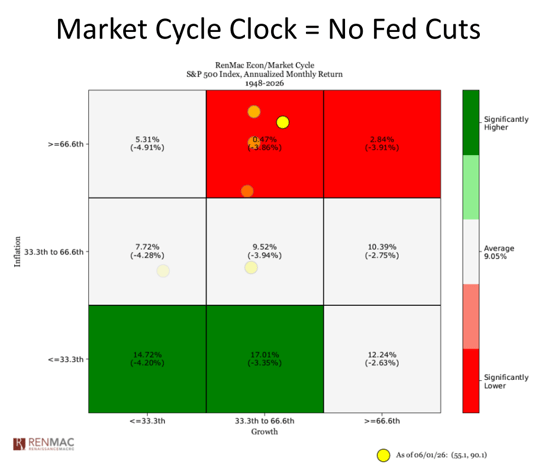
RenMac Off-Script Podcast
.png?width=717&height=403&name=6526%20(2).png)
RenMac Calendar

Research Notes
Economics
- US labor market continues its downtrend. Weekly job postings continue to trend down, layoffs picking up, quits are cooling.
- March data showed broad economic weakness, with declines in services, confidence, housing, and commercial real estate.
- Rising inflation, weakening job outlooks, and cautious business spending point to growing economic strain.
- Home prices are cooling, which may curb spending as household wealth dips and the savings rate edges higher.
- The rebound in capital goods shipments looks fragile, with growth mostly tied to tech and broader investment plans weakening.
- New tariffs could cut 0.5% from GDP, strain trade ties, and raise car prices before production shifts take effect.
- Auto repossessions are at their highest since 2009, and tariffs may push buyers to the used market, keeping prices elevated.
- Despite trade tensions, signs of de-escalation and strong profits offer some cushion, with markets already pricing in much of the downside.
- Q4 growth was lifted by consumer and government spending, but with investment falling and key supports fading, a broader slowdown seems likely.
Strategy
- Market technicals show potential for a rebound. We think Mag7 approaches 50dma and potentially crosses through, getting to overbought, high beta stocks slowly recovering, and excessive outflows in IWM and SPY could fuel a tactical bounce.
- Remember, this was a beta-driven correction, not a momentum-driven one.
- Remember, this was a beta-driven correction, not a momentum-driven one.
- Bullish signals may re-emerge if a high percentage of stocks move about their 20dma and hit 20-day highs, suggesting a reassertion of the bull trend.
- Despite heightened policy uncertainty and a dark cross in tech, strong credit markets and sentiment tied to returns suggest the current pessimism may be overdone.
- Semi's continue to weaken, with even "good" ones coming under pressure.
- Staples pulled back at resistance levels, maintaining relative downtrend. Sharp unwind in beta and extreme underperformance suggests continued downward pressure.
- Transports reiterate bearish trend but flagging oversold and in "seller's frenzy". Expect short-term tactical bounce but fade the move.
Policy
- Debt limit deadline ("X-Date") likely between July and October, with resolution hinging on reconciliation or bipartisan deal amid uncertain cash flows.
- Delays risk market volatility and a Moody's downgrade, raising U.S. borrowing costs.
- Delays risk market volatility and a Moody's downgrade, raising U.S. borrowing costs.
- Trump will announce reciprocal tariffs on April 2, targeting about 15 key partners; recent moves on oil, autos, and threats to the EU and Canada may be strategic leverage.
- Section 232 is being used more broadly to justify tariffs on national security grounds, covering autos, copper, timber, and pharma, with an emphasis on U.S. production.
- Tariff timing and scope remain unclear, with Trump using them as a flexible tool, adding to market uncertainty.
Asset Allocation Model
 Sector Ranks
  Chart of the week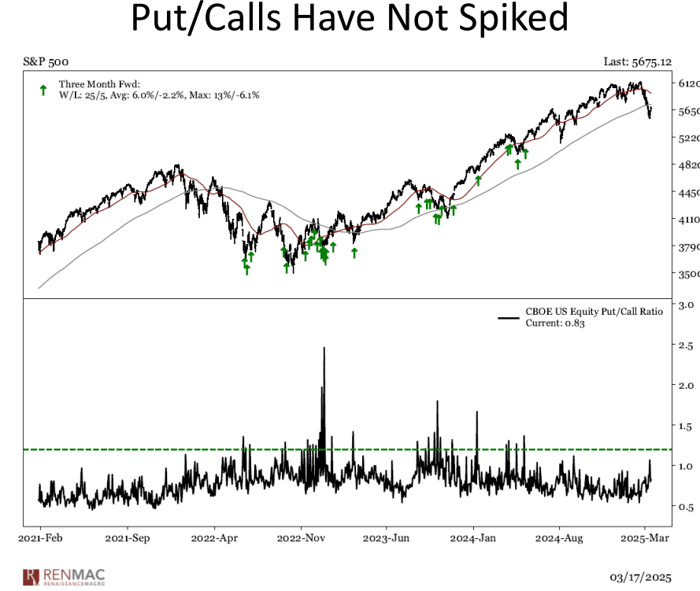
Sector Ranks Chart of the week