Research Notes
Strategy
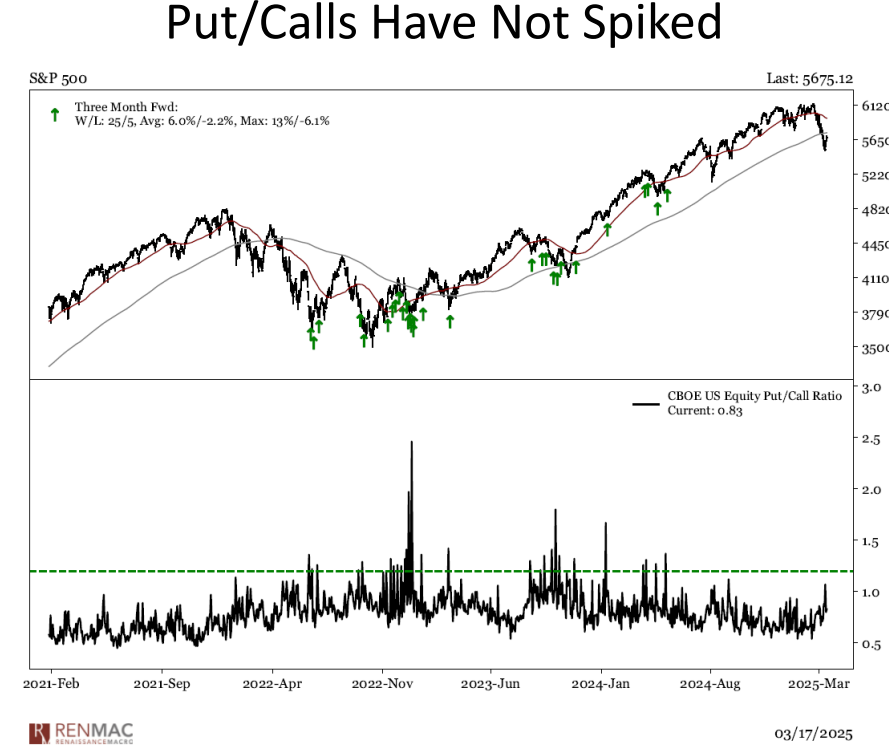
- Several of the sentiment measures we monitor have been flashing extreme readings, including Consensus Inc. and the 25-DMA of the Composite Put/Call Ratio.
- Others, such as SPY ETF inflows have just flashed as extreme for the first time in over a year and our S&P 500 options sentiment indicator is very close.
- While elevated sentiment alone is not a reason to turn bearish, it is important to recognize the implications of these readings. When positioning becomes heavily skewed to the long side, any reversal in price can unfold much more rapidly as crowded trades begin to unwind.
- The dollar index is back at resistance that has capped gains for the past year, but the pattern is looking more like a base this time, suggesting its poised to breakout.
- Yen intervention becomes more likely with a breakout in the dollar and gold's prospects for punching through resistance seems less likely.
- The response to the overbought condition in Software we highlighted two weeks ago has been abysmal. The IGV ETF is off over 15% since and a massive topping pattern is clearly taking shape.
- Airlines continue to benefit from the drop in oil as the JETS ETF retests the YTD highs while the relative breaks out.
- Retail is another group that is benefitting from lower oil prices as the XRT ETF closes in on the top of the range that's capped advances for the past 10 months. Retail recently flagged as extreme negative excess returns in SERM for the first time since the late-90s.
- The group is still in a relative downtrend and less than half of the components are above their 200-DMA's so selectivity remains important.
- Retail is another group that is benefitting from lower oil prices as the XRT ETF closes in on the top of the range that's capped advances for the past 10 months. Retail recently flagged as extreme negative excess returns in SERM for the first time since the late-90s.
- After a lengthy consolidation following a strong 2025 performance, the EW Biotech ETF, XBI finally broke out above its range to new 5-year highs. The chart is a massive base and returns are not stretched in SERM suggesting further room to run.
- The EW Pharma ETF, XPH also joined the party and broke out to 10-year highs in what is also a massive base.
Economics
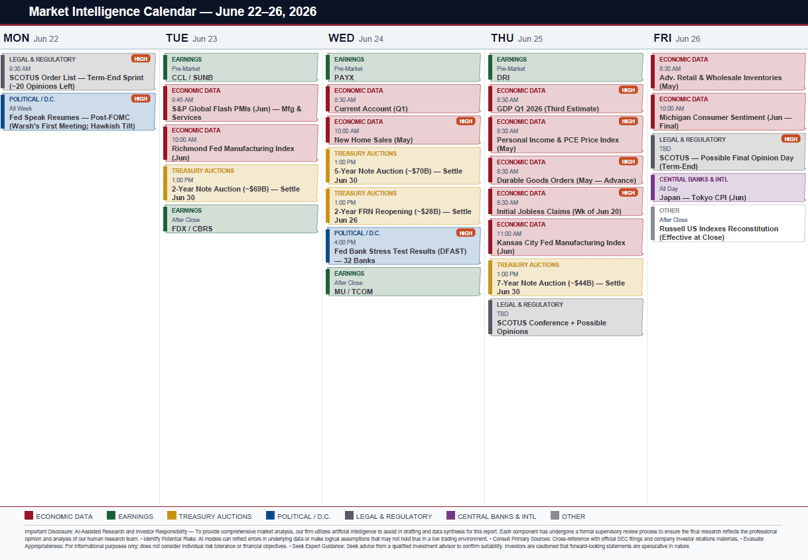
- Compared to his predecessors, Warsh's debut was the most hawkish first press conference. When comparing this to all 91 other first press conferences since 2011, the surge in the 2Y Treasury note yield was the largest up-move on record. The surprise here is the relatively muted response in equity markets.
- When Warsh says "rules based monetary policy" he's not asking the Fed to mechanically plug numbers into the Taylor equation and let the funds rate fall out.
- Given Warsh's affinity for less discretion with respect to monetary policy, Neil doesn't think an investor really has any choice other than to simply anchor to a Taylor Rule.
- Most of these rules are saying hike, and it is discretion that was preventing the Fed from hiking under Powell.
- By saying nothing, Warsh has allowed the information vacuum to be filled by others, and they are mostly saying hike too. If you don't give a reaction function, you have to default to something.
- The slowdown is wage growth is broad-based, not confined to education and healthcare. Median industry wage growth has fallen from over 5% in 2022 to 3.8%, with cooling evident across much of the economy.
- More than half of industries are still experiencing wage growth, though the breadth of the slowdown is beginning to stabilize as wage gains converge across sectors.
- While education and healthcare contributed meaningfully to the cooling, professional and business services and financials have been even larger drivers of the moderation.
- Wage growth for nonsupervisory workers, which accelerated the most during the post-pandemic period, has also cooled sharply and is now roughly in line with overall wage growth.
- Residential construction remains weak, with building permits falling to their softest 3-month pace since September 2025, driven primarily by a sharp slowdown in multifamily development.
- Housing starts plunged to a post-pandemic low, though most of the decline came from the volatile multifamily segment; single-family starts also weakened to their lowest level since September 2025.
- Weak new home sales and declining builder sentiment suggest limited support for a near-term rebound in construction activity.
- Weak new home sales and declining builder sentiment suggest limited support for a near-term rebound in construction activity.
- While the weakness is real, the concentration in multifamily projects likely exaggerates the severity of the downturn relative to underlying housing demand.
- The BoJ raised rates to 1.0%, its highest level since 1995, signaling growing confidence that underlying inflation is moving sustainably toward target.
- The hike appears preemptive rather than reactive, with policymakers focused on preventing higher energy costs and rising inflation expectations from pushing inflation above 2%.
- The BoJ softened its characterization of monetary policy, suggesting conditions are no longer exceptionally accommodative and reinforcing a gradual tightening bias.
- Markets now expect another rate hike to 1.25% later this year, contingent on continued wage growth and the evolution of geopolitical risks.
 Sector Ranks
  Chart of the weekRetail sales were stronger than expected in May, with core retail sales posting robust gains and running at a 7.5% annualized pace over the past three months. While the report points to solid consumer spending and boosted GDP tracking estimates, much of the strength appears concentrated in goods consumption, particularly online retail, rather than services. Restaurant spending softened and likely declined in real terms after inflation, suggesting consumer demand remains uneven, with goods holding up far better than services.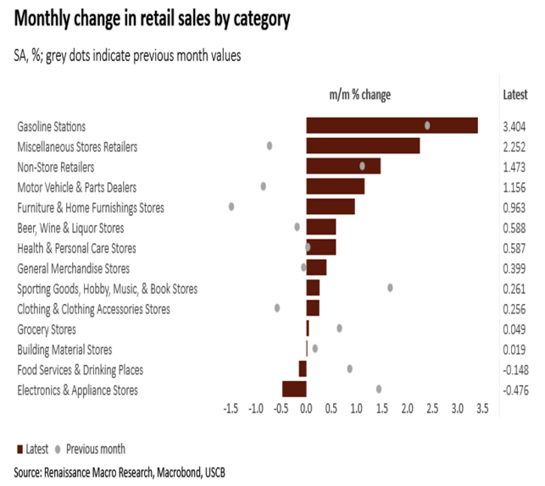
RenMac Off-Script Podcast

RenMac Calendar
Research Notes
Economics
- US labor market continues its downtrend. Weekly job postings continue to trend down, layoffs picking up, quits are cooling.
- March data showed broad economic weakness, with declines in services, confidence, housing, and commercial real estate.
- Rising inflation, weakening job outlooks, and cautious business spending point to growing economic strain.
- Home prices are cooling, which may curb spending as household wealth dips and the savings rate edges higher.
- The rebound in capital goods shipments looks fragile, with growth mostly tied to tech and broader investment plans weakening.
- New tariffs could cut 0.5% from GDP, strain trade ties, and raise car prices before production shifts take effect.
- Auto repossessions are at their highest since 2009, and tariffs may push buyers to the used market, keeping prices elevated.
- Despite trade tensions, signs of de-escalation and strong profits offer some cushion, with markets already pricing in much of the downside.
- Q4 growth was lifted by consumer and government spending, but with investment falling and key supports fading, a broader slowdown seems likely.
Strategy
- Market technicals show potential for a rebound. We think Mag7 approaches 50dma and potentially crosses through, getting to overbought, high beta stocks slowly recovering, and excessive outflows in IWM and SPY could fuel a tactical bounce.
- Remember, this was a beta-driven correction, not a momentum-driven one.
- Remember, this was a beta-driven correction, not a momentum-driven one.
- Bullish signals may re-emerge if a high percentage of stocks move about their 20dma and hit 20-day highs, suggesting a reassertion of the bull trend.
- Despite heightened policy uncertainty and a dark cross in tech, strong credit markets and sentiment tied to returns suggest the current pessimism may be overdone.
- Semi's continue to weaken, with even "good" ones coming under pressure.
- Staples pulled back at resistance levels, maintaining relative downtrend. Sharp unwind in beta and extreme underperformance suggests continued downward pressure.
- Transports reiterate bearish trend but flagging oversold and in "seller's frenzy". Expect short-term tactical bounce but fade the move.
Policy
- Debt limit deadline ("X-Date") likely between July and October, with resolution hinging on reconciliation or bipartisan deal amid uncertain cash flows.
- Delays risk market volatility and a Moody's downgrade, raising U.S. borrowing costs.
- Delays risk market volatility and a Moody's downgrade, raising U.S. borrowing costs.
- Trump will announce reciprocal tariffs on April 2, targeting about 15 key partners; recent moves on oil, autos, and threats to the EU and Canada may be strategic leverage.
- Section 232 is being used more broadly to justify tariffs on national security grounds, covering autos, copper, timber, and pharma, with an emphasis on U.S. production.
- Tariff timing and scope remain unclear, with Trump using them as a flexible tool, adding to market uncertainty.
Asset Allocation Model
 Sector Ranks
  Chart of the week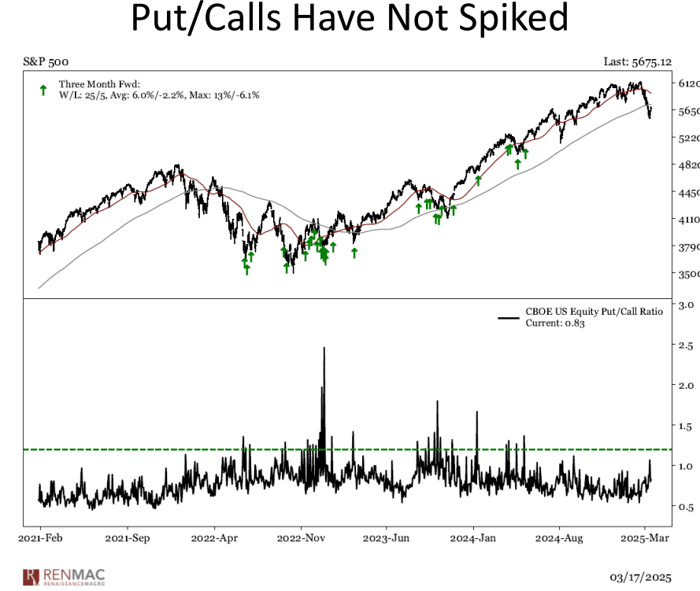
Sector Ranks Chart of the week