Research Notes
Strategy
- The coming AI IPO wave could be one of the largest ever. Expected listings from OpenAI, Anthropic, Cerebras, etc. could represent roughly 6% of the entire capitalization of the S&P, rivaling the dot-com era.
- History suggests caution after the IPO hype. Across 20 marquee IPOs, the median stock barely outperformed the market after 3 months and underperformed the S&P 500 by roughly 31% after one year, despite strong opening-day pops.
- Patience has often been the better trade. Lockup expirations, earnings visibility, and valuation adjustments frequently create more attractive entry points than buying immediately after a high-profile IPO.
- More on this can be found in this report in case you missed it Friday.
- Beta contracted and the % of issues above their 20-DMA expanded. If tops are a narrowing event, this one is either not complying, or it is not a top - our money is on factor rotation.
- What worked was value, banks, REITS, and healthcare, the momentum antithesis.
- The rotation leaves some loose ends, with the loosest being the consumer.
- Broadline retail has rolled over on a relative basis.
- Auto-retail is flashing an exit.
- Housewares are overbought within a downtrend
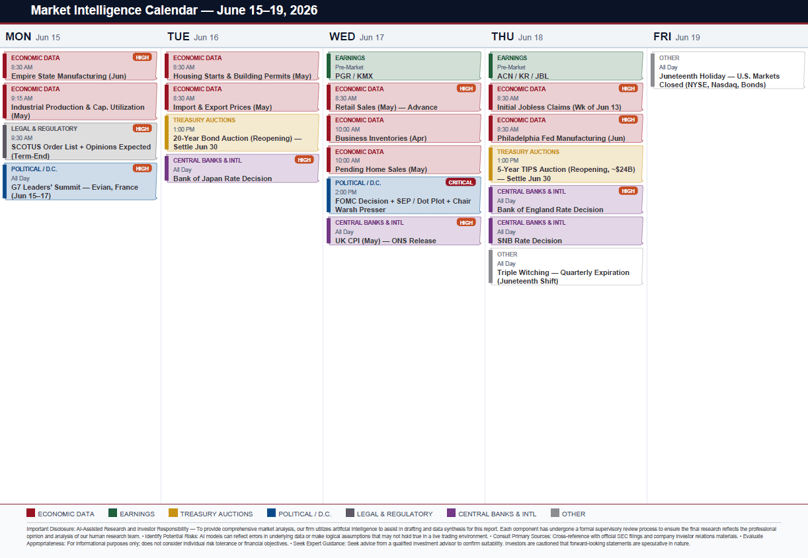
- Wednesday's CPI places it squarely in the top 90th percentile of our work, an economic data point with a statistically significant negative relationship with forward SPX returns. The concern for the Fed higher for longer is seen through rising real rates, which have a tendency to hit long-duration assets the hardest.
- Real rates took the bid, and duration paid for it. That was apparent in the high vs low beta contraction we saw, and to a lesser extent the weakness in high momentum names.
- The story is corroborated by gold and silver which are now oversold but within teetering uptrend, and uranium which is tracing out a more uncomfortable top formation.
- The Russell 2000 continues to consolidate around the highs within a strong trend. The relative price of R2K vs R1K looks poised to finally breakout of the relative range it's been trapped in since late-January.
- The big relative base and the fact that excess relative returns for R2K vs R1K are far from extreme in SERM, suggests there is still a long runway for small vs large-cap outperformance.
Economics
- The case for additional Fed hikes remains weak, as recent payroll growth has not pushed unemployment lower, suggesting the labor market may be able to absorb more job gains without overheating.
- Wage growth remains subdued, providing little evidence that labor market tightness is generating renewed inflation pressure.
- Several labor market indicators, including small business hiring plans, job openings, consumer sentiment, and PMI employment measures remain soft and do not support a strong reacceleration in hiring.
- Recent payroll data may overstate underlying labor market strength, raising the risk of weaker employment reports later this year.
- The most likely outcome is continued Fed patience rather than rate hikes, though financial conditions could still tighten through higher bond yields and a stronger USD.
- Headline inflation was driven by energy, not broad-based price pressures. CPI rose 0.47% in May, pushing the annual rate to 4.2%, but more than 60% of the monthly increase came from energy, particularly gasoline.
- Core CPI rose just 0.21%, but the weakness was concentrated in a handful of categories. Measures that strip out these outsized moves continue to run closer to 3-4%, suggesting underlying inflation remains sticky.
- Services inflation remains the problem with shelter, medical services, recreation, and airfares all staying firm.
- Core goods prices declined for the first time this year, while computer and software prices were largely unchanged, reducing near-term concerns about an AI-driven inflation surge.
- Bottom line: The report was better than the headline CPI suggests but worse than the headline core suggests. Energy drove the inflation spike, while temporary category-specific declines flattered the core reading. Underneath, services inflation remains sticky enough to keep hawkish Fed concerns alive.
- NFIB small business optimism slipped to its lowest level since October 2024, though the survey's historical relationship with GDP has weakened significantly, limiting its usefulness as a growth signal.
- Underlying details were softer, with capital spending plans remaining at cycle lows and hiring intentions falling to their weakest level since 2020, pointing to slower payroll growth ahead.
- Job openings among small businesses continued to decline, while compensation plans were unchanged, suggesting labor demand is cooling but wage pressures are not deteriorating further.
- One headwind for small firms in the coming months will be higher borrowing costs. The % of regular borrowers paying higher interest rates than 3 months ago climbed to 6%, the highest since Sept 2025. Given the recent back-up in interest rates, we'd expect average borrowing costs to increase further.
- Existing home sales rose to their highest level since December, but because sales reflect contracts signed months earlier, recent increases in mortgage rates are likely to weigh on activity in the months ahead.
- Inventory continues to improve, with single-family listings up over 5% YoY, while home price growth has slowed to roughly flat in real terms after inflation.
- The composition of sales is becoming healthier, with first-time buyers accounting for a larger share of purchases and investor activity falling to its lowest level in nearly a year.
 Sector Ranks
  Chart of the weekThere was quite a bit of heat from the May PPI data. Translating details of CPI and PPI, we estimate that core PCE will climb 0.33 percent in May. We’re looking at another month of core PCE inflation running at 4.0 percent SAAR. Not good.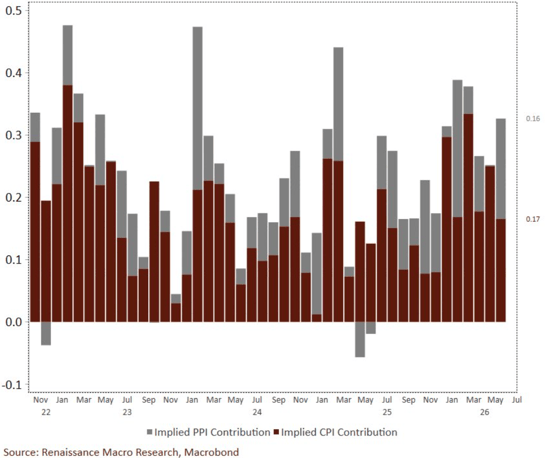
RenMac Off-Script Podcast
-2.png?width=717&height=403&name=01-16-26%20RenMac%20-%202%20(1)-2.png)
RenMac Calendar
Research Notes
Economics
- US labor market continues its downtrend. Weekly job postings continue to trend down, layoffs picking up, quits are cooling.
- March data showed broad economic weakness, with declines in services, confidence, housing, and commercial real estate.
- Rising inflation, weakening job outlooks, and cautious business spending point to growing economic strain.
- Home prices are cooling, which may curb spending as household wealth dips and the savings rate edges higher.
- The rebound in capital goods shipments looks fragile, with growth mostly tied to tech and broader investment plans weakening.
- New tariffs could cut 0.5% from GDP, strain trade ties, and raise car prices before production shifts take effect.
- Auto repossessions are at their highest since 2009, and tariffs may push buyers to the used market, keeping prices elevated.
- Despite trade tensions, signs of de-escalation and strong profits offer some cushion, with markets already pricing in much of the downside.
- Q4 growth was lifted by consumer and government spending, but with investment falling and key supports fading, a broader slowdown seems likely.
Strategy
- Market technicals show potential for a rebound. We think Mag7 approaches 50dma and potentially crosses through, getting to overbought, high beta stocks slowly recovering, and excessive outflows in IWM and SPY could fuel a tactical bounce.
- Remember, this was a beta-driven correction, not a momentum-driven one.
- Remember, this was a beta-driven correction, not a momentum-driven one.
- Bullish signals may re-emerge if a high percentage of stocks move about their 20dma and hit 20-day highs, suggesting a reassertion of the bull trend.
- Despite heightened policy uncertainty and a dark cross in tech, strong credit markets and sentiment tied to returns suggest the current pessimism may be overdone.
- Semi's continue to weaken, with even "good" ones coming under pressure.
- Staples pulled back at resistance levels, maintaining relative downtrend. Sharp unwind in beta and extreme underperformance suggests continued downward pressure.
- Transports reiterate bearish trend but flagging oversold and in "seller's frenzy". Expect short-term tactical bounce but fade the move.
Policy
- Debt limit deadline ("X-Date") likely between July and October, with resolution hinging on reconciliation or bipartisan deal amid uncertain cash flows.
- Delays risk market volatility and a Moody's downgrade, raising U.S. borrowing costs.
- Delays risk market volatility and a Moody's downgrade, raising U.S. borrowing costs.
- Trump will announce reciprocal tariffs on April 2, targeting about 15 key partners; recent moves on oil, autos, and threats to the EU and Canada may be strategic leverage.
- Section 232 is being used more broadly to justify tariffs on national security grounds, covering autos, copper, timber, and pharma, with an emphasis on U.S. production.
- Tariff timing and scope remain unclear, with Trump using them as a flexible tool, adding to market uncertainty.
Asset Allocation Model
 Sector Ranks
  Chart of the week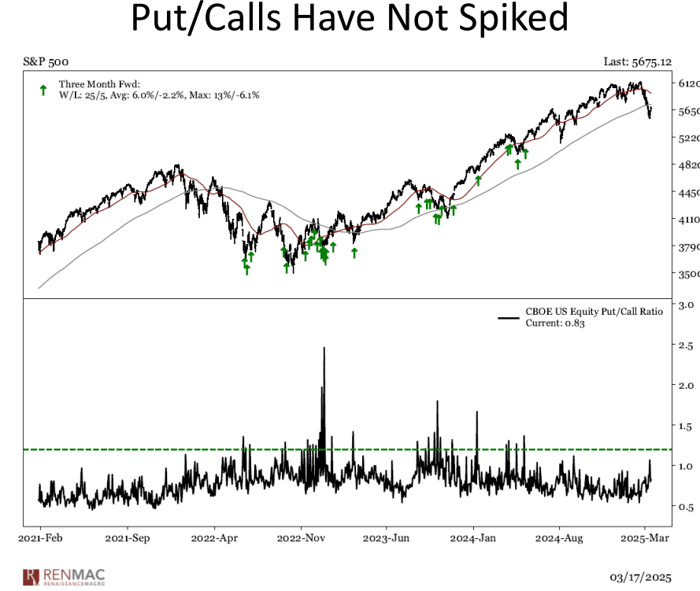
Sector Ranks Chart of the week