Research Notes
Strategy
- The latest data from Investors Intelligence shows a slight jump in the Bull-Bear spread but still not an extreme reading. That’s comforting, however, most other sentiment measures are already flashing warning signs including Consensus Inc, SPX positioning data and ETF inflows for SPY and Q’s.
- We don’t make market calls based off sentiment alone but given our views about a continued unwind in momentum and deteriorating seasonals, the sentiment headwinds are certainly a reason for some caution.
- Oil lit the fuse Thursday, but the damage was one layer down in the real yields. Brent’s headlines gave the tape an excuse but the reverberations into 30-year TIPS pushed real yields towards 3% levels we haven’t seen since 2008, and what matters in our view.
- Nominal rates pushed our yield impact model into the top decile, levels that typically cause the S&P to churn over the next 2-3 months. The tape read the memo.
- Nominal rates pushed our yield impact model into the top decile, levels that typically cause the S&P to churn over the next 2-3 months. The tape read the memo.
- Tactically, we think there is room for a bounce in semis as the oversold condition works off but longer-term, we still think there is further but more gradual weakness in store for momentum.
- Since momentum spans across most leadership trends in the Tech sector and that the Software ETF, IGV is rolling over in a big top.
- We don’t see one industry stepping in to replace Semi’s as sector leadership so the focus should be more selective and stock specific going forward.
- The best gameplan in Tech going forward will likely be a much more selective approach, not every name in Semis will outperform nor should every name in Software be avoided.
- In 2000 financial conditions were tightening while sentiment was running hot against a selective bubble backdrop. It’s a condition that appears so disjointed and commonsensical in retrospect to believe it happened, and unlikely to replicate.
- It has taken 26 years, but real yields are tightening financial conditions after our bubble signal triggered in April and recent ETF flow data suggests investors are anxious to get exposure.
- It’s not about the stories, those change, it’s the “big rocks” that matter and create the foundation, the sand of the narrative is just the filler between those spaces.
- Market breadth remains constructive but lacks strong momentum. The equal weight oscillator has not reached a new high, trends are still positive, and new lows remain contained, which does not suggest the kind of deterioration typically seen near major market tops.
- Investor sentiment is becoming more optimistic, with rising S&P inflows. Historically, higher inflows have been associated with weaker forward 3m returns, although returns have generally remained positive rather than turning negative.
- The main takeaway is caution rather than alarm. Current breadth and sentiment indicators are not flashing major warning signs, but growing investor enthusiasm has historically led to below average future returns, making inflows an important trend to monitor.
Economics
- The case for a July rate hike has strengthened as inflation remains above target, the labor market is stable, AI-driven demand is firm, tariff pressures persist, and higher oil prices threaten to keep inflation elevated.
- While consensus expects the Fed to hold in July and hike in September, recent economic developments closely match the conditions outlined in the June FOMC minutes that policymakers said would warrant further tightening.
- Recent improvements in inflation have been relatively narrow, with non-housing services inflation still elevated and rising energy prices likely to put renewed pressure on headline inflation in the months ahead.
- Although the votes for a July hike may not yet be there, several FOMC members are already leaning hawkish, and a rate hike remains firmly on the table for this year.
- A July hike would also give Chair Warsh greater flexibility, allowing him to establish inflation-fighting credibility early rather than being forced into a September move in inflation remains stubborn.
- Global PMI surveys improved in July, led by a rebound in manufacturing activity across Europe, the UK and Japan, suggesting global growth regained some momentum after a softer second quarter.
- Japan's manufacturing sector continues to strengthen, pointing to firmer industrial production in the months ahead, while India stands out as a relative laggard as higher oil prices weigh on activity.
- Input cost pressures eased in July, but the improvement may be short-lived given the recent rebound in oil prices and escalating Middle East tensions, which could reignite inflation pressures in coming months.
- New home sales modestly beat expectations in June, but activity has largely stalled over the past three months as builders increasingly rely on price cuts to move elevated inventories of completed homes, pressuring homebuilder revenues.
- With mortgage rates moving higher after the survey period, housing demand is likely to soften further in Q3, keeping a lid on new construction until excess inventory is worked down.
- Several high-frequency indicators suggest economic growth is losing momentum in Q3, with signs of softness emerging across manufacturing, housing, consumer spending, and the labor market.
- Mortgage purchase applications and raw steel production have both weakened in recent weeks, pointing to slower activity in housing and industrial sectors.
 Sector Ranks
  Chart of the weekThere has been almost no progress on 30-year fixed rate mortgages over the last year. At 6.75%, the rate is essentially unchanged from a year ago. Not surprisingly as rates have increased, we have seen mortgage purchase demand cool off along with housing stocks.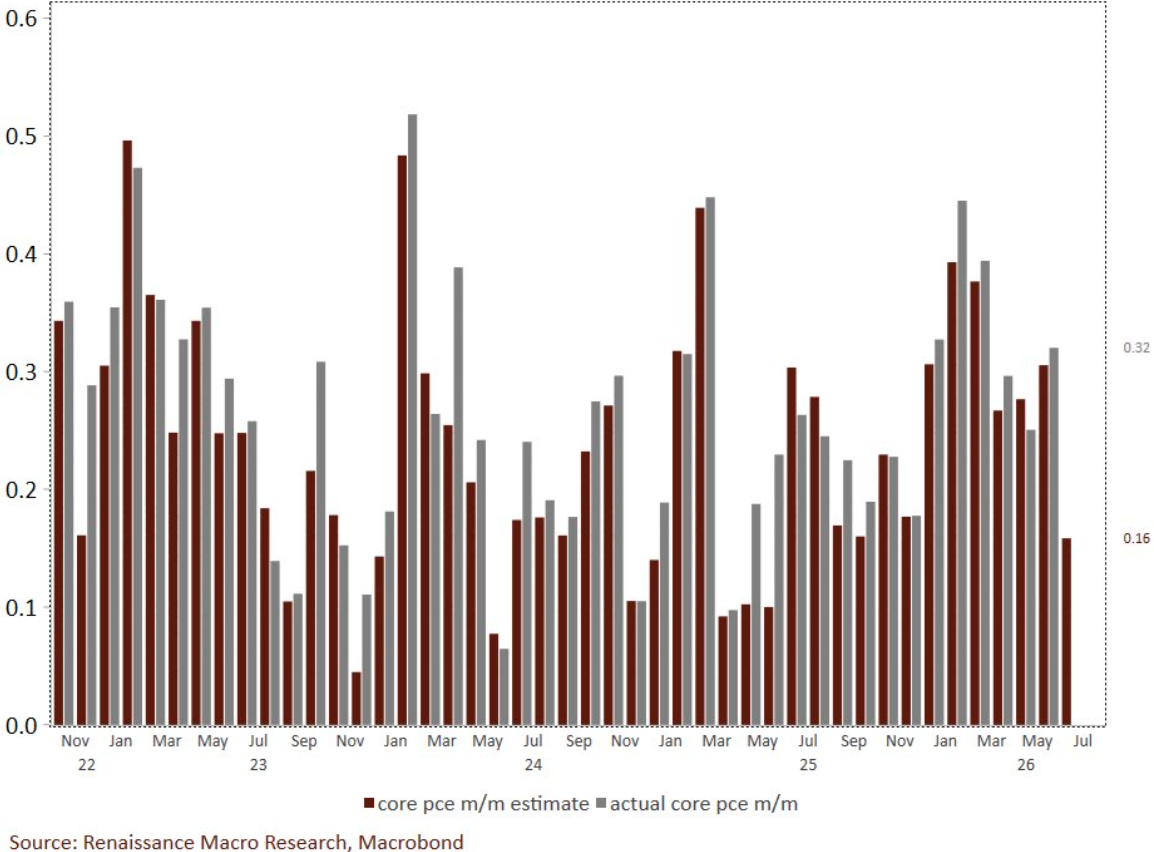
RenMac Off-Script Podcast
-4.png?width=717&height=403&name=01-16-26%20RenMac%20-%202%20(1)-4.png)
RenMac Calendar

Research Notes
Economics
- US labor market continues its downtrend. Weekly job postings continue to trend down, layoffs picking up, quits are cooling.
- March data showed broad economic weakness, with declines in services, confidence, housing, and commercial real estate.
- Rising inflation, weakening job outlooks, and cautious business spending point to growing economic strain.
- Home prices are cooling, which may curb spending as household wealth dips and the savings rate edges higher.
- The rebound in capital goods shipments looks fragile, with growth mostly tied to tech and broader investment plans weakening.
- New tariffs could cut 0.5% from GDP, strain trade ties, and raise car prices before production shifts take effect.
- Auto repossessions are at their highest since 2009, and tariffs may push buyers to the used market, keeping prices elevated.
- Despite trade tensions, signs of de-escalation and strong profits offer some cushion, with markets already pricing in much of the downside.
- Q4 growth was lifted by consumer and government spending, but with investment falling and key supports fading, a broader slowdown seems likely.
Strategy
- Market technicals show potential for a rebound. We think Mag7 approaches 50dma and potentially crosses through, getting to overbought, high beta stocks slowly recovering, and excessive outflows in IWM and SPY could fuel a tactical bounce.
- Remember, this was a beta-driven correction, not a momentum-driven one.
- Remember, this was a beta-driven correction, not a momentum-driven one.
- Bullish signals may re-emerge if a high percentage of stocks move about their 20dma and hit 20-day highs, suggesting a reassertion of the bull trend.
- Despite heightened policy uncertainty and a dark cross in tech, strong credit markets and sentiment tied to returns suggest the current pessimism may be overdone.
- Semi's continue to weaken, with even "good" ones coming under pressure.
- Staples pulled back at resistance levels, maintaining relative downtrend. Sharp unwind in beta and extreme underperformance suggests continued downward pressure.
- Transports reiterate bearish trend but flagging oversold and in "seller's frenzy". Expect short-term tactical bounce but fade the move.
Policy
- Debt limit deadline ("X-Date") likely between July and October, with resolution hinging on reconciliation or bipartisan deal amid uncertain cash flows.
- Delays risk market volatility and a Moody's downgrade, raising U.S. borrowing costs.
- Delays risk market volatility and a Moody's downgrade, raising U.S. borrowing costs.
- Trump will announce reciprocal tariffs on April 2, targeting about 15 key partners; recent moves on oil, autos, and threats to the EU and Canada may be strategic leverage.
- Section 232 is being used more broadly to justify tariffs on national security grounds, covering autos, copper, timber, and pharma, with an emphasis on U.S. production.
- Tariff timing and scope remain unclear, with Trump using them as a flexible tool, adding to market uncertainty.
Asset Allocation Model
 Sector Ranks
  Chart of the week
Sector Ranks Chart of the week