Research Notes
Strategy
- The termination of the ceasefire from oils oversold condition couldn't have been timed better for crude and energy longs; the oscillator was set before the missiles flew. Semis bounced from our most sensitive oversold measure with 2% of issues above their 20-DMA as of Wednesday's close and nearly 87% of names triggering as "oversold" on a 14-day stochastic.
- Tech's Q1 vs Q5 momentum spread has given back half the spike that drove performance to 80% (that's actual 65-day return) last quarter, that's in the 100th percentile historically, but at 23% 65-day return now, we've only reverted to the 91st percentile.
- We can judge a tape qualitatively by it's actual vs. expected behavior. In a downtrend, overbought conditions, trend-line and moving average resistance levels should contain strength, while support levels fail and asymmetric deeper oversold conditions are required to germinate a rally. The opposite can be said for uptrends.
- Thursday's rebound in semis fulfills the oversold condition holding which is good news for bulls, but is it durable?
- The dominant backdrop is that the momentum trade is failing, and the record is clear: momentum extremes don't soften softly, they revert completely and relatively quickly. Those are the two opposing forces, and both are true at the same time.
- Short term rally is likely, but within the context of a broader, more dangerous, deterioration.
- Market leadership continues to broaden, with equal-weight stocks, small caps, and overall market breadth confirming the uptrend, suggesting this bull market is healthier than many investors realize.
- At the same time, tightening financial conditions driven by shifting Fed expectations, rather than actual rate hikes, are beginning to pressure momentum and other risk-sensitive areas beneath the surface.
- Watch this video for more on this from Jeff deGraaf
- Our yield impact model remains bullish as 10s priced 4.58% at Wednesday's auction, the richest concession since Feb '25, but indirect bids took up 81% suggesting demand is fine at these prices.
- What we saw in our 5yr-5yr forward decomposition was a slight CONTRACTION in inflation expectations with nominal yields being driven by real rates (which translated into tighter financial conditions).
- We don't like it, but we don't see it as a derailing mechanism yet, though it's notable that French OATs and JGB 10s both made breakout yield high Wednesday.
Economics
- In Waller, Chairman Warsh finds an ally in dropping forward guidance for the time being but also someone that wants to communicate a reaction function and is currently warming to the idea of a rate hike.
- In short, Waller notes that the risks have flipped toward inflation while the labor markets are stabilizing.
- Labor markets are in balance, and not much of a source of disinflationary or inflationary pressure while underlying inflation has firmed.
- We see no point in hiking if you are going to do it just once, but the dynamics of the committee and Warsh's unwillingness to fill the void with his own view lead us to believe that if there was a Fed that would hike just once, it would be this one under Warsh.
- In short, Waller notes that the risks have flipped toward inflation while the labor markets are stabilizing.
- During the nomination process, Warsh was an advocate for an AI-driven productivity boom. By his telling, under this framework, the Fed would have space to ease monetary policy as the supply-side expanded. There is just one problem - the data are not supportive of the idea.
- PMIs are broadly consistent with 2.0% percent real GDP. With employment indices perking up, it stands to reason that productivity is not especially strong.
- If the economy is modestly growing while hiring is perking up, there is no productivity and someone is losing money on their investment.
- PMIs are broadly consistent with 2.0% percent real GDP. With employment indices perking up, it stands to reason that productivity is not especially strong.
- High-frequency retail indicators are sending mixed signals, with Redbook sales accelerating while Bloomberg's Second Measure (a historically more reliable predictor of Census retail sales) continues to weaken.
- The divergence suggests consumer spending may be moderating as Q3 begins, despite strength in some traditional retail measures.
- The market is pricing in roughly 3.5% U.S. GDP growth according to our calculations. We take the changes in the S&P 500, credit spreads, 10Y yields, and the broad USD exchange rate to estimate GDP growth. In short, tight credit spreads and rising share prices are implying a stronger economic growth backdrop.
- Despite the GDP backdrop implied by financial markets, actual US GDP growth has been no great shakes. Over the last two quarters, US real GDP has advanced by just 1.3% SAAR. The Atlanta Fed GDPNow is bean-counting growth of 1.2% in Q2. Private domestic demand is running close to 2% over this period.
- A new NY Fed study suggests the inflationary impact of tariffs is far from over, with nearly half of affected firms still planning additional price increases in the months ahead.
- Many businesses are delaying price hikes due to fixed-price contracts or raising prices gradually to avoid customer pushback, extending the inflationary effects of tariffs.
- Rather than a one-time adjustment, ongoing tariff uncertainty is likely to keep price pressures elevated for longer than many expect.
 Sector Ranks
  Chart of the weekA potential source of upward inflation pressure in services in June: Hotels and motels. Industry data implies upward price pressure in average daily hotel room rates over the month. World Cup pushing up room-rates in host cities?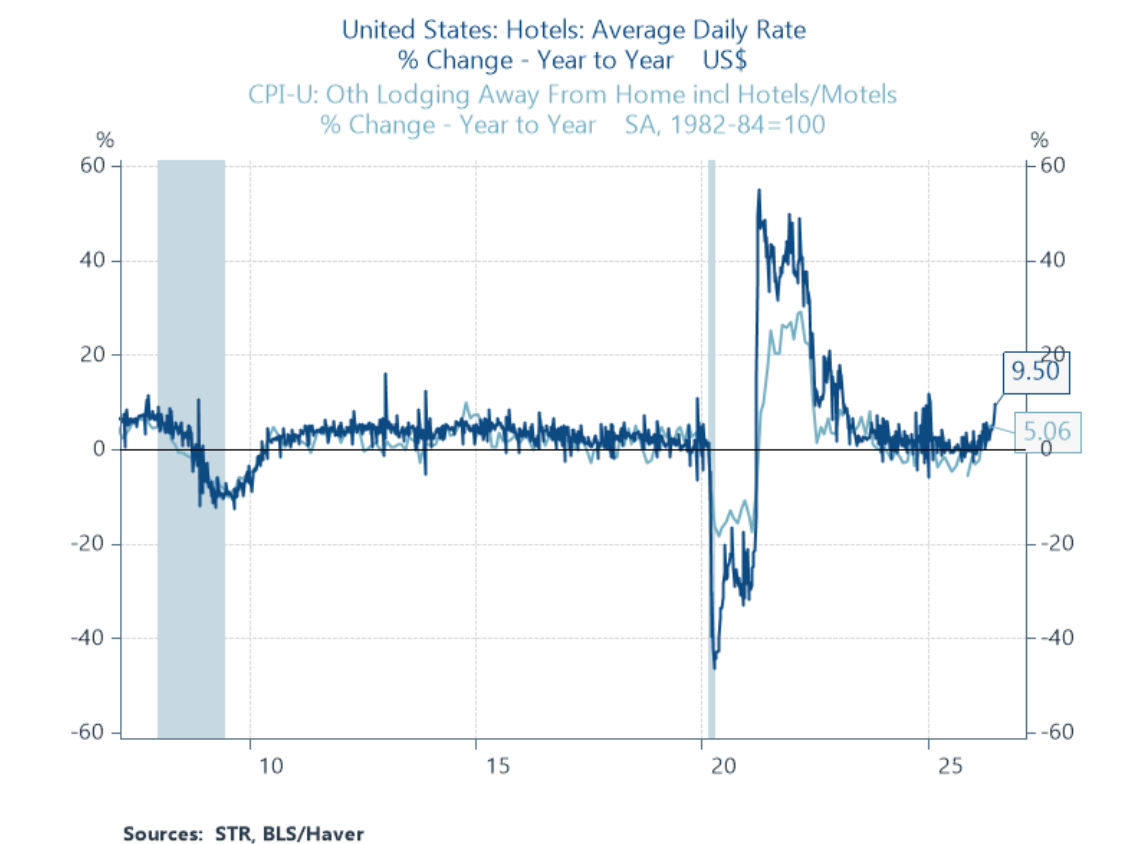
RenMac Off-Script Podcast

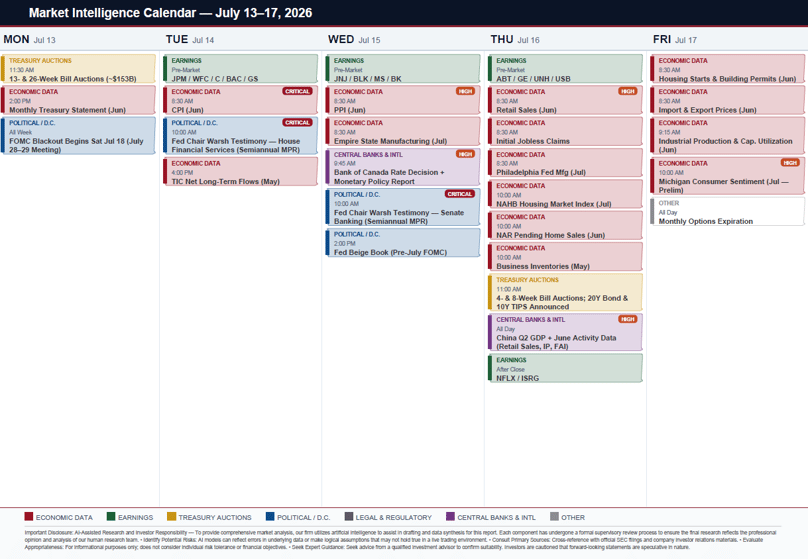
RenMac Calendar
Research Notes
Economics
- US labor market continues its downtrend. Weekly job postings continue to trend down, layoffs picking up, quits are cooling.
- March data showed broad economic weakness, with declines in services, confidence, housing, and commercial real estate.
- Rising inflation, weakening job outlooks, and cautious business spending point to growing economic strain.
- Home prices are cooling, which may curb spending as household wealth dips and the savings rate edges higher.
- The rebound in capital goods shipments looks fragile, with growth mostly tied to tech and broader investment plans weakening.
- New tariffs could cut 0.5% from GDP, strain trade ties, and raise car prices before production shifts take effect.
- Auto repossessions are at their highest since 2009, and tariffs may push buyers to the used market, keeping prices elevated.
- Despite trade tensions, signs of de-escalation and strong profits offer some cushion, with markets already pricing in much of the downside.
- Q4 growth was lifted by consumer and government spending, but with investment falling and key supports fading, a broader slowdown seems likely.
Strategy
- Market technicals show potential for a rebound. We think Mag7 approaches 50dma and potentially crosses through, getting to overbought, high beta stocks slowly recovering, and excessive outflows in IWM and SPY could fuel a tactical bounce.
- Remember, this was a beta-driven correction, not a momentum-driven one.
- Remember, this was a beta-driven correction, not a momentum-driven one.
- Bullish signals may re-emerge if a high percentage of stocks move about their 20dma and hit 20-day highs, suggesting a reassertion of the bull trend.
- Despite heightened policy uncertainty and a dark cross in tech, strong credit markets and sentiment tied to returns suggest the current pessimism may be overdone.
- Semi's continue to weaken, with even "good" ones coming under pressure.
- Staples pulled back at resistance levels, maintaining relative downtrend. Sharp unwind in beta and extreme underperformance suggests continued downward pressure.
- Transports reiterate bearish trend but flagging oversold and in "seller's frenzy". Expect short-term tactical bounce but fade the move.
Policy
- Debt limit deadline ("X-Date") likely between July and October, with resolution hinging on reconciliation or bipartisan deal amid uncertain cash flows.
- Delays risk market volatility and a Moody's downgrade, raising U.S. borrowing costs.
- Delays risk market volatility and a Moody's downgrade, raising U.S. borrowing costs.
- Trump will announce reciprocal tariffs on April 2, targeting about 15 key partners; recent moves on oil, autos, and threats to the EU and Canada may be strategic leverage.
- Section 232 is being used more broadly to justify tariffs on national security grounds, covering autos, copper, timber, and pharma, with an emphasis on U.S. production.
- Tariff timing and scope remain unclear, with Trump using them as a flexible tool, adding to market uncertainty.
Asset Allocation Model
 Sector Ranks
  Chart of the week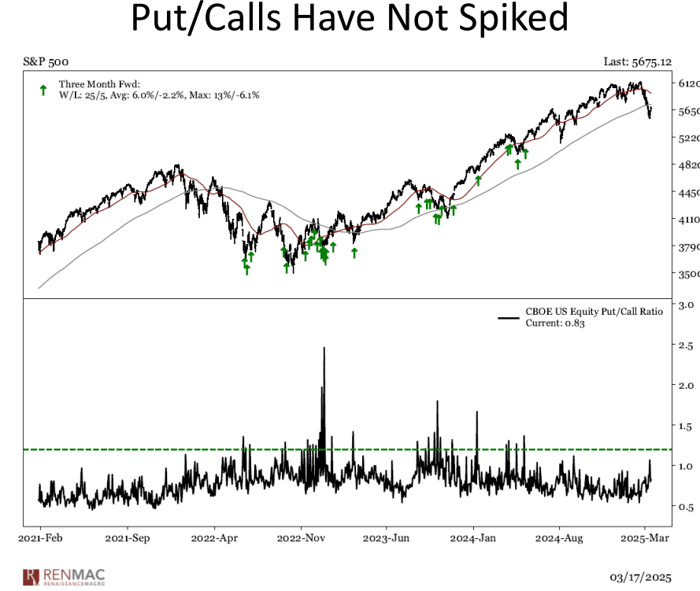
Sector Ranks Chart of the week